
APA Citation In Text: In-Text Citation Rules and Examples (7th Edition)
Show contents
- What an APA in-text citation does
- Parenthetical vs narrative citations
- One, two, three or more authors
- Group authors and works with no author
- No date, in press and same-year works
- Quotes with page or paragraph numbers
- Multiple works in one parenthesis
- Secondary sources: "as cited in"
- Citing a website in text
- Citations inside a paragraph
- Common mistakes to check
- Checking your work with a generator
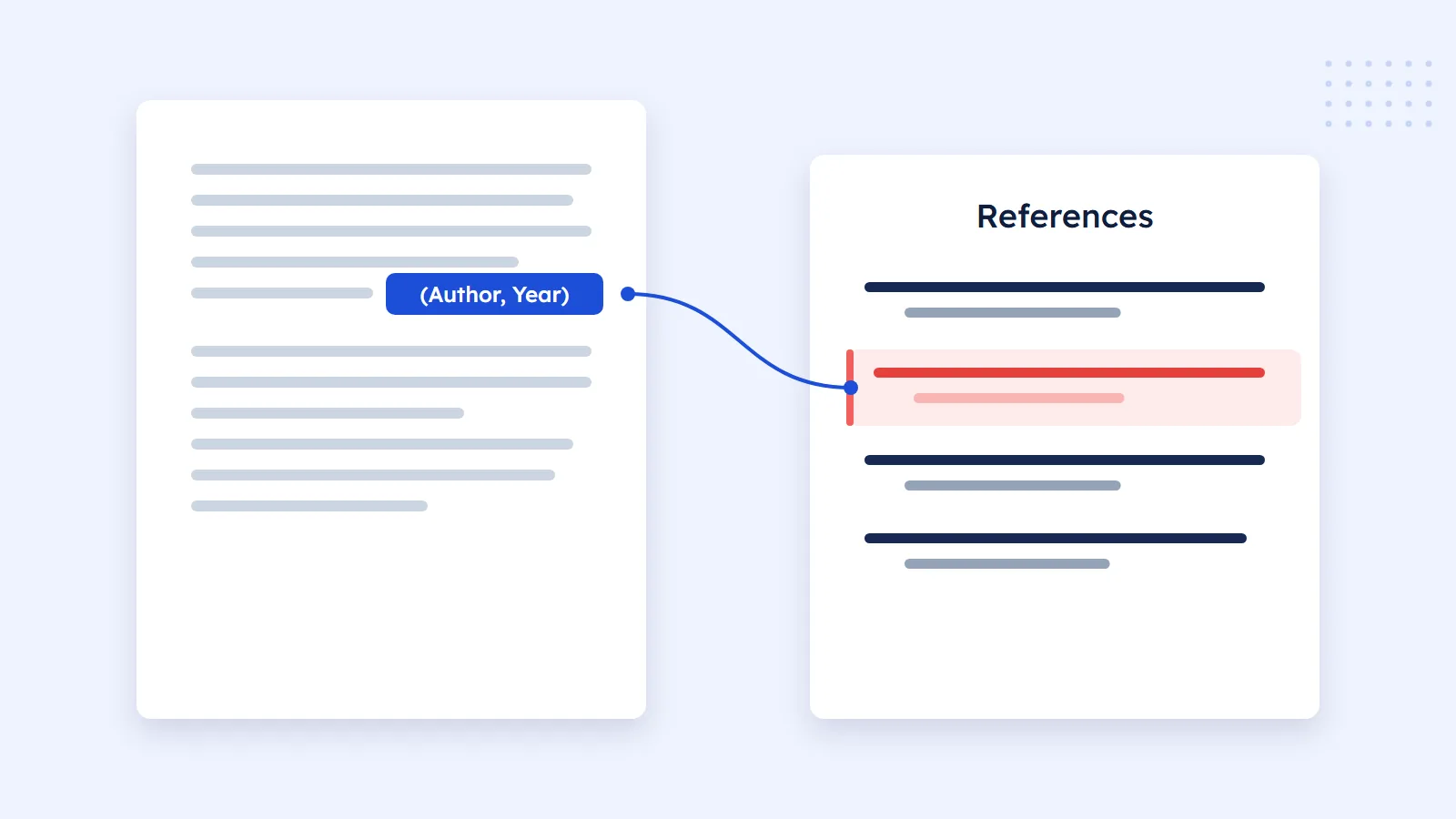
An APA citation in text is a short credit inside your sentence that names the author and the year of the work you used, for example (Koehler, 2016) or Koehler (2016). In APA 7th edition, every in-text citation points to one full entry in the reference list at the end of the paper. When you quote word for word, you also add a page or paragraph number.
The details change with the number of authors, missing dates, quotes, websites and secondhand sources. This guide covers each case with examples from the official APA Style pages, so you can check any APA citation in text in seconds.
What an APA in-text citation does
APA uses what it calls the author-date system. According to APA Style's basic principles of citation, the in-text citation "briefly identifies the cited work by its author and date of publication" so readers can find the matching entry in the alphabetical reference list.
Three rules from that page do most of the work:
- Each work you cite in the text must appear in the reference list, and each reference list entry must be cited in the text.
- Both paraphrases and quotations need a citation. Rewording an idea does not remove the need to credit it.
- The spelling of author names and the year must match between the citation and the reference entry.
Our view: most lost marks on APA papers are not about commas. They come from a citation that has no partner in the reference list, or a reference entry nobody cites. Checking that pairing first catches more errors than polishing punctuation.
Parenthetical vs narrative citations
APA in-text citations come in two formats, and APA describes both on its parenthetical versus narrative page. You can mix them freely in one paper. Pick the one that reads better in each sentence.
Parenthetical citations
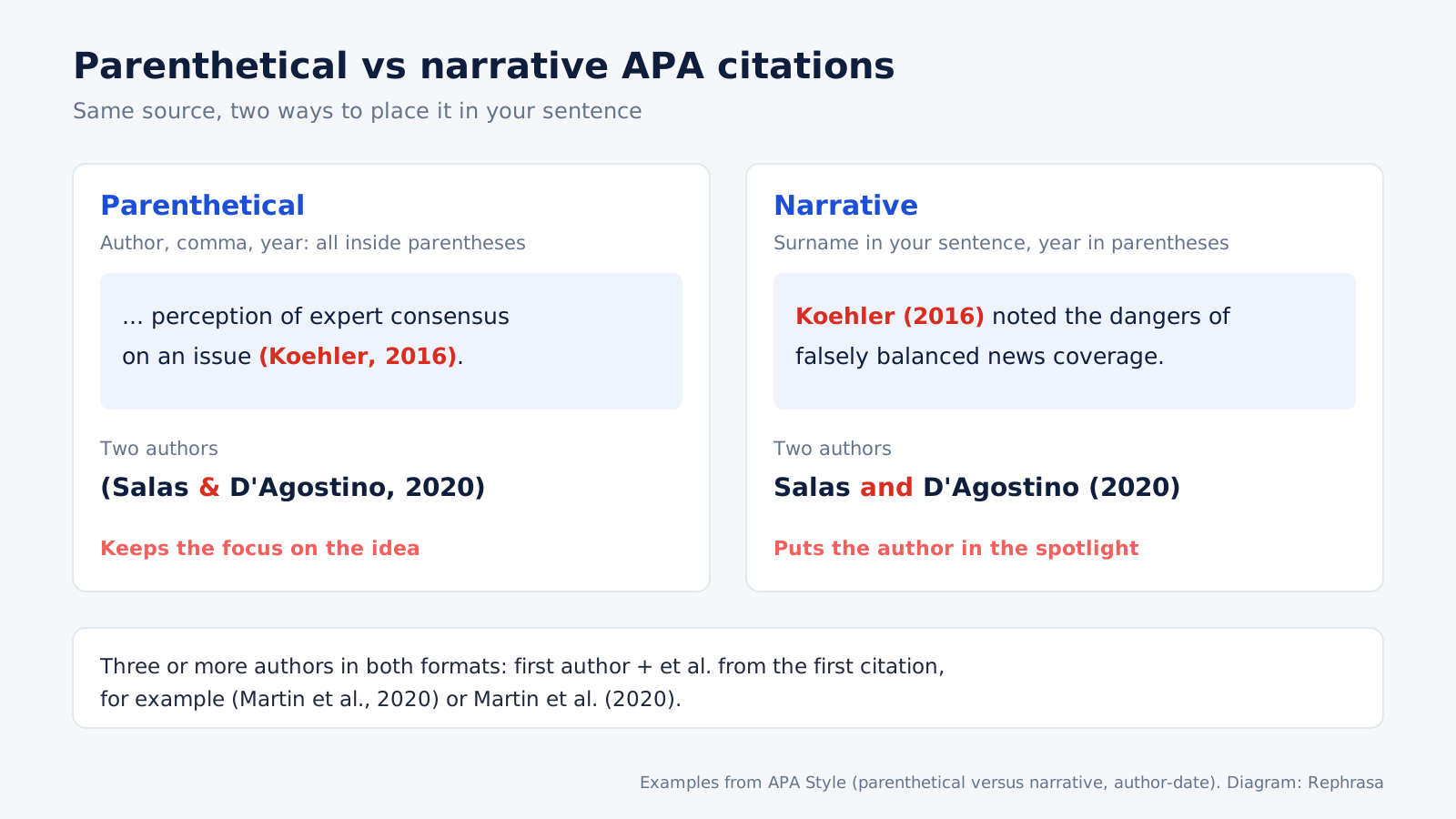
The author and the year sit together in parentheses, separated by a comma, usually at the end of the sentence:
Falsely balanced news coverage can distort the public's perception of expert consensus on an issue (Koehler, 2016).
If other text shares the parentheses, put commas around the year, as in (see Koehler, 2016, for more detail). If a phrase and a citation share parentheses, separate them with a semicolon, as in (e.g., falsely balanced news coverage; Koehler, 2016). Never nest parentheses inside parentheses.
Narrative citations
The author's surname becomes part of your sentence and the year follows it in parentheses:
Koehler (2016) noted the dangers of falsely balanced news coverage.
In the rare case that both author and year appear in the sentence, drop the parentheses: "In 2016, Koehler noted..." Use narrative citations when the author matters to your argument; parenthetical ones keep the focus on the idea.
One, two, three or more authors
The author part of an APA citation in text changes with the number of authors. The APA author-date page sets these rules for the 7th edition:
| Author type | Parenthetical | Narrative |
|---|---|---|
| One author | (Luna, 2020) | Luna (2020) |
| Two authors | (Salas & D'Agostino, 2020) | Salas and D'Agostino (2020) |
| Three or more authors | (Martin et al., 2020) | Martin et al. (2020) |
| Group author with abbreviation, first citation | (National Institute of Mental Health [NIMH], 2020) | National Institute of Mental Health (NIMH, 2020) |
| Group author with abbreviation, later citations | (NIMH, 2020) | NIMH (2020) |
| Group author without abbreviation | (Stanford University, 2020) | Stanford University (2020) |
Two details trip people up. First, use an ampersand (&) between two names inside parentheses, but spell out "and" in a narrative citation. Second, for three or more authors, use the first author plus "et al." in every citation, even the first one. APA marks this guidance as revised from the 6th edition, so older templates may still show the long form.
Purdue OWL adds two useful notes: only "al." takes a period (never "et. al."), and if two of your sources would shorten to the same "et al." form, write out as many surnames as you need to tell them apart, such as (Jones, Smith, Liu, et al., 2020) and (Jones, Smith, Ruiz, et al., 2020). If two first authors share a surname, add their initials: (E. Johnson, 2001; L. Johnson, 1998).
Group authors and works with no author
Organizations, agencies and universities can be authors. Spell out the full name on first use. If the group has a familiar abbreviation, give it once in square brackets (parenthetical) or in the parentheses with the year (narrative), then use only the abbreviation afterwards. APA's note under the table says to define the abbreviation only once in the text.
When a work truly has no author, the APA missing reference information table moves the title into the author position. The citation then becomes (Title, year) or Title (year). Purdue OWL explains the formatting: titles that are italic in the reference list (books, reports, standalone webpages) stay italic in the text, while titles of articles and chapters go in quotation marks, both in title case. A shortened title is fine, as in ("Using Citations," 2001).
Do not write "Anonymous" just because no name is shown. APA allows (Anonymous, 2017) only when the work is actually signed "Anonymous."
Before you settle on "no author," look again. Many webpages that seem anonymous are published by an organization, and that organization is the author.
No date, in press and same-year works
APA keeps only the year in the in-text citation, even when the reference entry has a full date such as 2021, October 1. The author-date guidance covers the other date cases:
- No date: write "n.d." for "no date," as in (Author, n.d.) or Author (n.d.).
- Accepted but not yet published: write "in press," as in (Author, in press).
- Same author, same year: add a lowercase letter after the year. APA's same author and date page shows (Blondaux & O'Hanrahan, 2018a) and Blondaux and O'Hanrahan (2018b). The letters follow the order of the titles in the reference list, and undated works become n.d.-a, n.d.-b.
The letter appears in both the citation and the reference entry. Add a third paper by the same author and the letters may shift, so recheck them.
Quotes with page or paragraph numbers
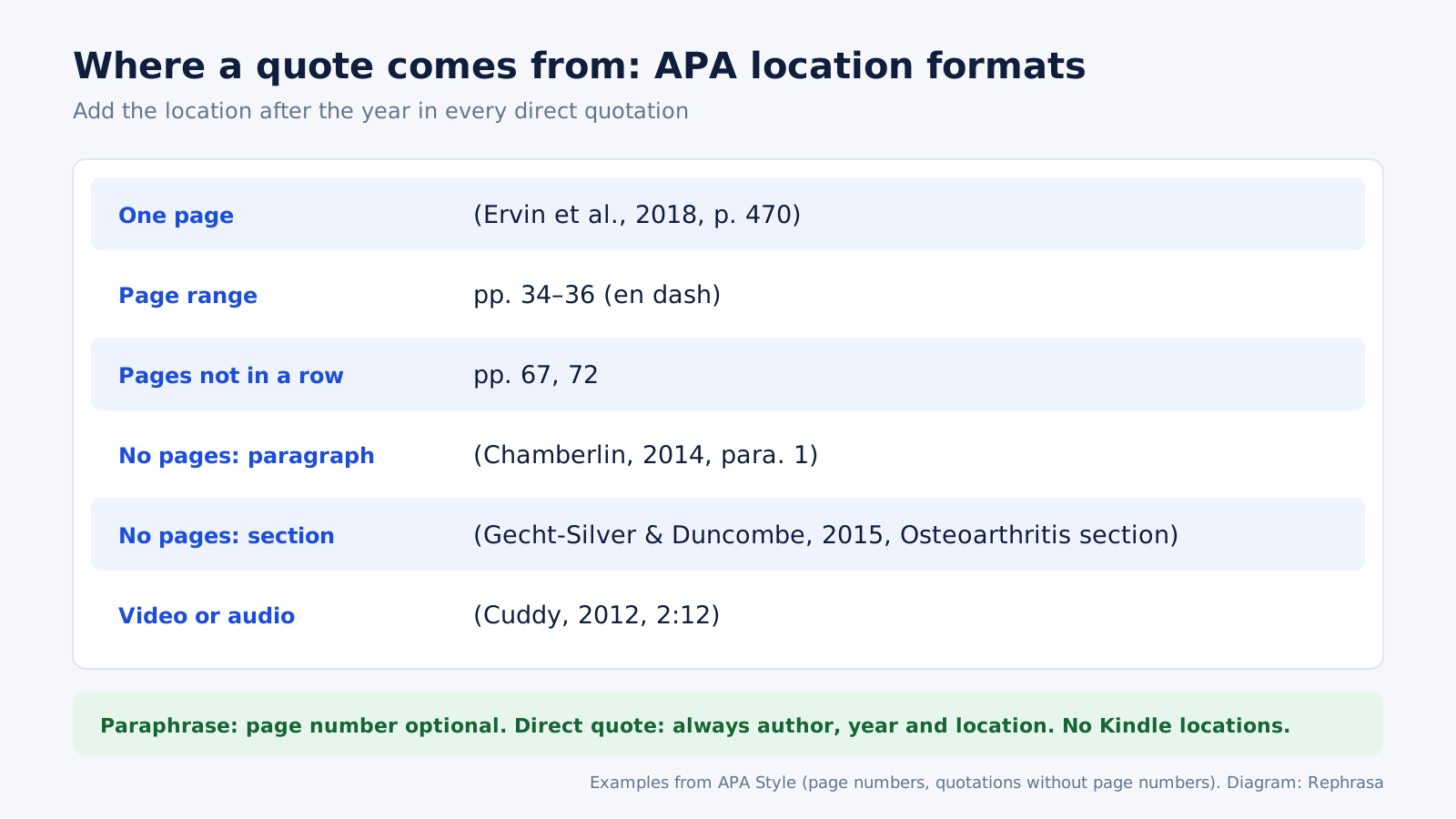
Quotes need more location detail than paraphrases. APA says that when quoting directly you always give the author, year and page number. Use "p." for one page and "pp." for a range joined with a dash, for example pp. 34-36. Discontinuous pages take a comma: pp. 67, 72.
Short quotations (fewer than 40 words)
Put the quoted words in quotation marks and keep them in your sentence. The APA quotations page gives this example:
Effective teams can be difficult to describe because "high performance along one domain does not translate to high performance along another" (Ervin et al., 2018, p. 470).
With a narrative citation, the author and year go in the sentence and the page number follows the quote in parentheses. The final period goes after the closing parenthesis.
Block quotations (40 words or more)
Start the quote on a new line, indent the whole block 0.5 in. from the left, double-space it, and drop the quotation marks. The citation comes after the final punctuation of the block, and no period follows it.
Sources without page numbers
Webpages and many ebooks have no pages. APA lists three alternatives: a paragraph number, as in (Chamberlin, 2014, para. 1); a heading or section name, as in (Gecht-Silver & Duncombe, 2015, Osteoarthritis section); or both together. For videos and audio, give a time stamp for the start of the quote, such as (Cuddy, 2012, 2:12). Kindle location numbers are not used.
For paraphrases, a page number is optional. The APA paraphrasing page suggests adding one when it would help a reader find the passage in a long work such as a book. We think it is worth it in literature reviews.
Multiple works in one parenthesis
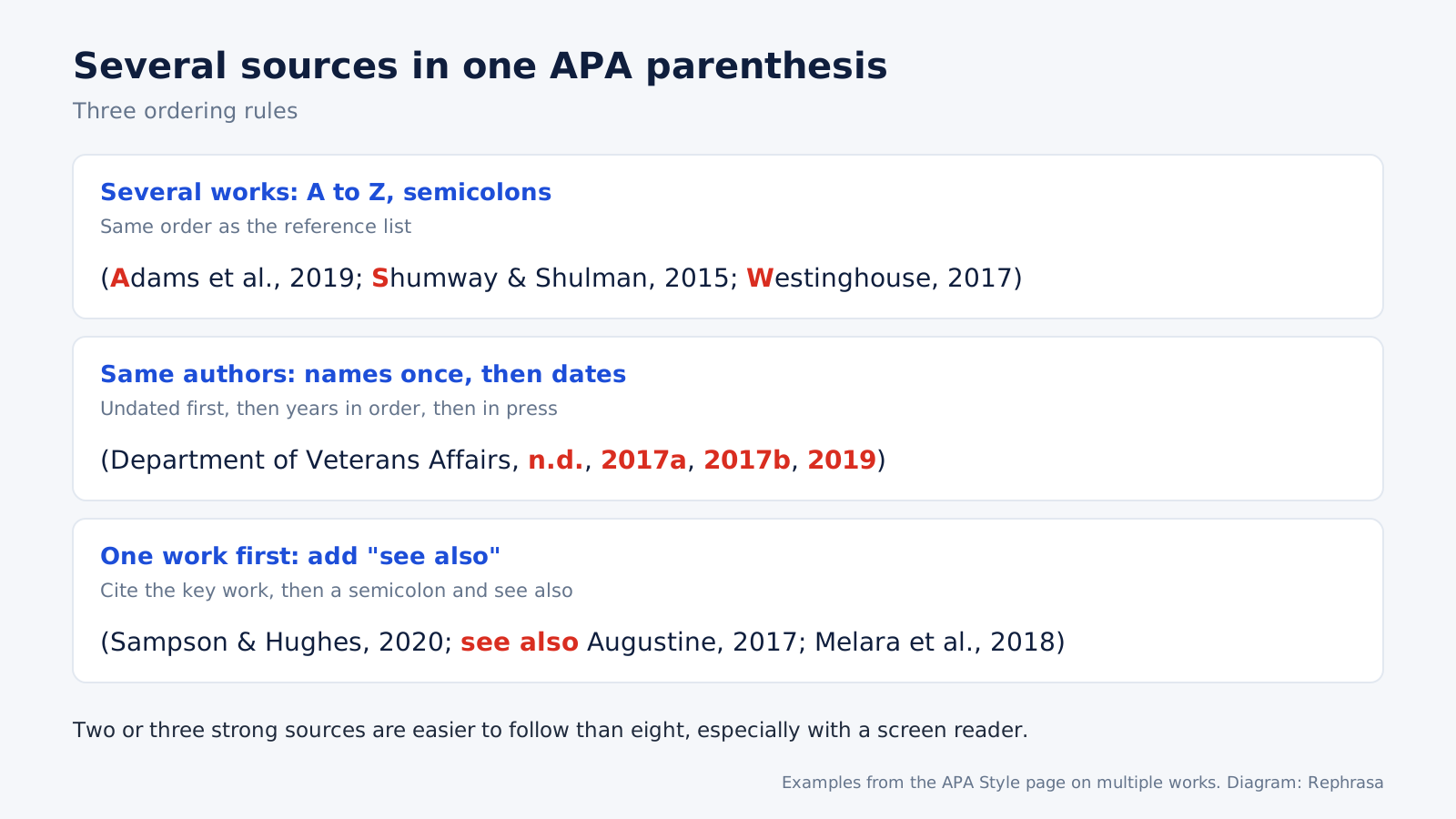
When several studies support one point, place them in the same parentheses. The APA multiple works page sets the order:
- Sort the works alphabetically, the same way they appear in the reference list, and separate them with semicolons: (Adams et al., 2019; Shumway & Shulman, 2015; Westinghouse, 2017).
- For several works by the same authors, give the names once and then the dates: undated works first, then years in order, then in-press works, as in (Department of Veterans Affairs, n.d., 2017a, 2017b, 2019).
- To put the most relevant work first, cite it, then add a semicolon and "see also" before the rest: (Sampson & Hughes, 2020; see also Augustine, 2017; Melara et al., 2018).
In a narrative sentence, any order works. APA also notes that long citation strings are hard to follow, especially with screen readers. Two or three strong sources beat eight.
Secondary sources: "as cited in"
A secondary source is one that reports another author's work. APA asks you to cite these sparingly, for instance when the original is out of print or in a language you cannot read. Where you can, find and cite the original instead.
If you must use one, name the original work, then write "as cited in" and the source you actually read:
(Rabbitt, 1982, as cited in Lyon et al., 2014)
Only Lyon et al. goes in the reference list, because that is the work you read. If the original year is unknown, leave it out: Allport's diary (as cited in Nicholson, 2003). Honestly, if your argument leans on a study a textbook summarizes, find the study. Secondhand summaries can drift from the original findings.
Citing a website in text
Citing a website in text follows the same author-date pattern. The APA webpage reference examples show three common cases:
- Named writer: (Schaeffer, 2021) for an article by K. Schaeffer on the Pew Research Center site.
- Organization with no named writer: (World Health Organization, 2018). The organization is the author.
- Page that changes and has no date: (U.S. Census Bureau, n.d.). Its reference entry adds a retrieval date, but the citation does not.
Use the year only, and cite the specific page you used, not the homepage. Because most webpages lack page numbers, quotes from them use para. or a section name as described above. Emails, private messages and unrecorded talks are a different case: the missing-information table treats them as personal communications, cited only in the text, as in (C. C. Communicator, personal communication, month day, year), with no reference entry.
Citations inside a paragraph
Does every sentence need its own APA citation in text? No. APA's rules on repeating a citation are more relaxed than many expect:
- Parenthetical citations always include both author and year.
- In a narrative citation, you can drop the year the second and later times you name the same work within one paragraph. Start each new paragraph with the year again.
- If you cite several works by the same author, keep the year every time so readers know which one you mean.
- APA does not use "ibid." Repeat the full citation instead.
For a long paraphrase that runs over several sentences, the paraphrasing guidance says to cite on first mention and not repeat it while the context makes clear you are still describing the same work. Cite again when you switch sources or start a new paragraph. Our rule of thumb: if a reader could reasonably wonder whose idea a sentence is, add the citation.
Common mistakes to check
Run through this list before you submit:
- "et. al." with a period after "et." The correct form is "et al."
- Listing all authors of a three-author paper on first mention, which was 6th edition practice.
- Using "and" inside parentheses or "&" in a narrative sentence.
- Giving the full date in the text instead of the year only.
- A quote with no page, paragraph or time-stamp location.
- Writing "Anonymous" for a page that simply has no byline.
- Putting the original work in the reference list when you only read it "as cited in" another source.
- A citation with no matching reference entry, or the reverse.
The last one matters most, and building the reference list as you write prevents it. If you also need the paper layout itself, our APA format guide covers margins, headings and the reference page.
Checking your work with a generator
A citation tool can save time on the reference entries. The free APA citation generator on Rephrasa builds the reference entry from a DOI, URL or ISBN and shows the matching in-text citation, so the two always agree. You can switch to other styles in the main citation generator, or compare with the MLA citation generator and our guide to MLA in-text citations if your course uses MLA.
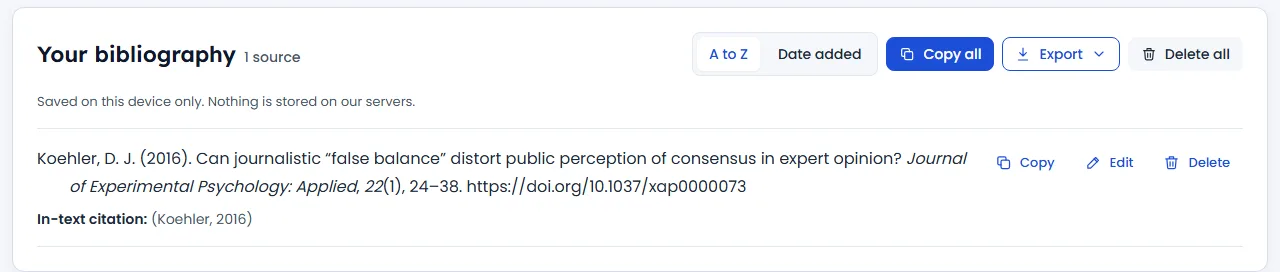
Two cautions: website metadata is often incomplete, so check author, year and title, and no tool knows which page you quoted, so add page numbers yourself.
The same honesty rule applies to rewording. A paraphrase, whether you write it yourself or start from the academic paraphrasing tool, is still someone else's idea and still needs an APA in-text citation. Our guide on how to paraphrase shows how to reword a passage properly and cite it, and the broader guide to in-text citations compares APA with other styles.
Frequently asked questions
How do you write an APA citation in text?
Give the author's surname and the year of publication, either in parentheses, as in (Luna, 2020), or in your sentence, as in Luna (2020). Add a page number such as p. 25 when you quote directly. Every citation must match one entry in the reference list.
How do you cite two authors in APA in-text citations?
Name both authors every time. Inside parentheses, join them with an ampersand: (Salas & D'Agostino, 2020). In a narrative citation, spell out and: Salas and D'Agostino (2020).
When do you use et al. in APA 7?
For any work with three or more authors, use the first author's surname plus et al. in every citation, including the first one, for example (Martin et al., 2020). Write out more names only if two sources would otherwise shorten to the same form.
How do you cite a source with no author or no date in APA?
With no author, use the title in place of the author, as in (Title, 2020). With no date, write n.d., as in (Author, n.d.). Use Anonymous only when the work is actually signed Anonymous.
Do paraphrases need an APA in-text citation?
Yes. APA states that both paraphrases and quotations require citations. A page number is optional for a paraphrase but required for a direct quotation.
How do you cite a quote from a website with no page numbers?
Give a paragraph number, as in (Chamberlin, 2014, para. 1), a heading or section name, or both. For videos, use a time stamp for the start of the quote, such as (Cuddy, 2012, 2:12).
Is it et al. or et. al. in APA?
It is et al. Only "al." takes a period, because "et" is a complete word. Writing "et. al." is one of the most common mistakes in APA papers.
How do you cite a secondary source in APA?
Name the original work, then write "as cited in" and the source you actually read, for example (Rabbitt, 1982, as cited in Lyon et al., 2014). Only the source you read, here Lyon et al., goes in the reference list. APA asks you to use secondary sources sparingly.
Sources
- APA Style: Basic Principles of Citation
- APA Style: Parenthetical Versus Narrative In-Text Citations
- APA Style: Author-Date Citation System
- APA Style: Citing Works With the Same Author and Date
- APA Style: Quotations
- APA Style: Direct Quotation of Material With Page Numbers
- APA Style: Direct Quotation of Material Without Page Numbers
- APA Style: Paraphrases
- APA Style: Citing Multiple Works
- APA Style: Secondary Sources
- APA Style: Missing Reference Information
- APA Style: Webpage on a Website References
- Purdue OWL: In-Text Citations: Author/Authors (APA 7th Edition)