
APA Standard Format: A Complete Guide to APA Format (7th Edition)
Show contents
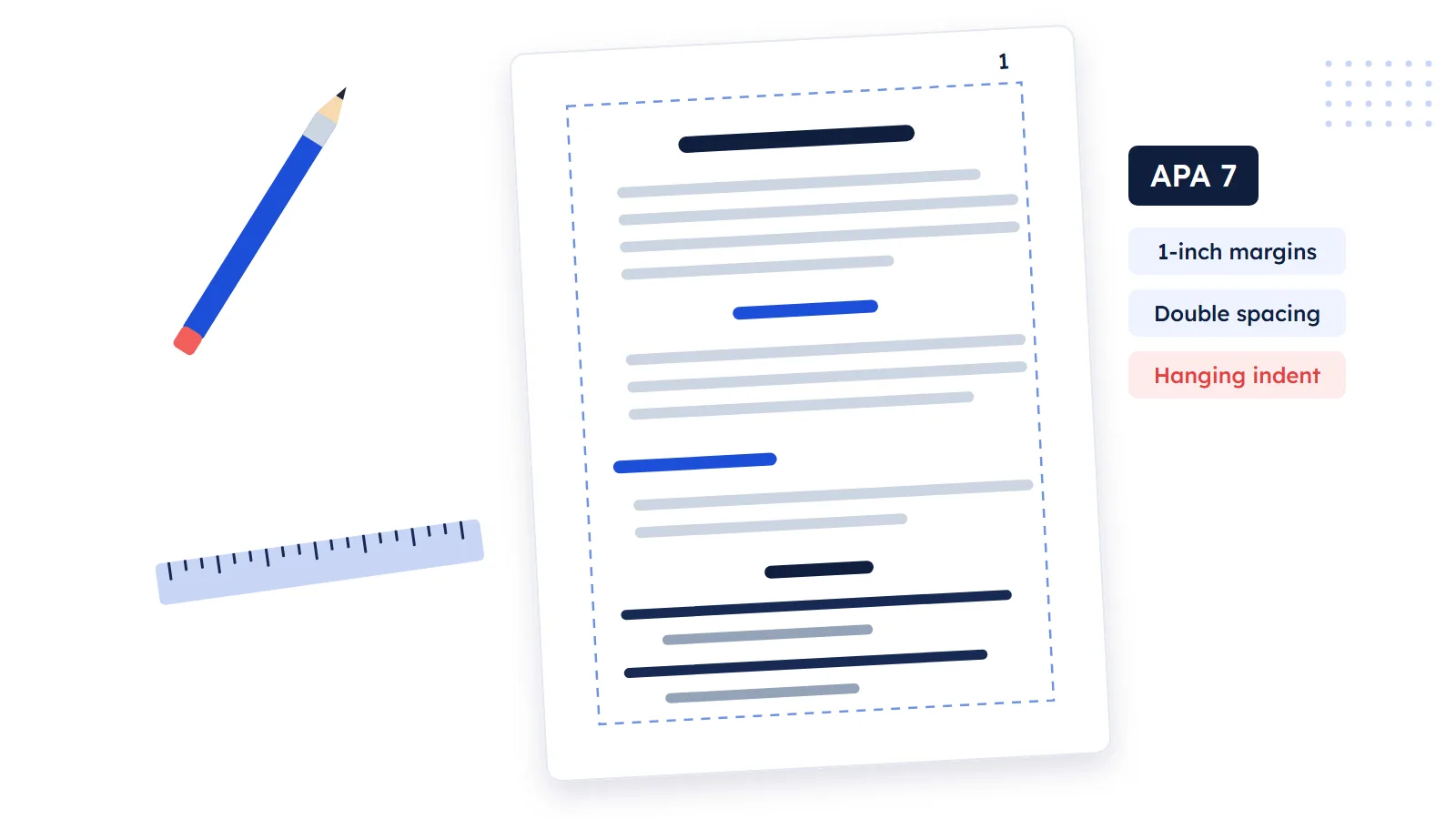
APA standard format is the set of layout and citation rules in the Publication Manual of the American Psychological Association, Seventh Edition: a readable font, 1-inch margins, double spacing, a page number in the top right corner, a title page, up to five levels of bold headings, author-date in-text citations, and a double-spaced reference list with a 0.5-inch hanging indent. If your instructor says "use APA" or "APA 7", this is what they mean.
This guide follows the order you build a paper, and each rule links to its official APA Style page so you can check it yourself. If your instructor gives a different rule, follow theirs.
What APA standard format covers
APA Style started in 1929 as a seven-page article in Psychological Bulletin, according to APA's own history page. Today the official source is the Publication Manual, Seventh Edition, which also covers writing style, bias-free language, and tables and figures.
When people search for APA standard format, they usually want two things from that manual:
- Paper format: how the pages look (font, margins, spacing, page header, title page, headings, order of pages).
- Citation format: how you credit sources, both inside your sentences and in the reference list at the end.
One detail many guides skip: these rules target student assignments and journal manuscripts. The APA paper format overview says that a website, poster or slide deck may need different spacing and font sizes.
A typical student paper has three required parts: a title page, the text, and references. The order of pages for a full paper is title page, abstract, text, references, footnotes, tables, figures, then appendices. Student papers generally skip the abstract unless the assignment asks for one.
APA paper setup: font, margins, spacing, page numbers
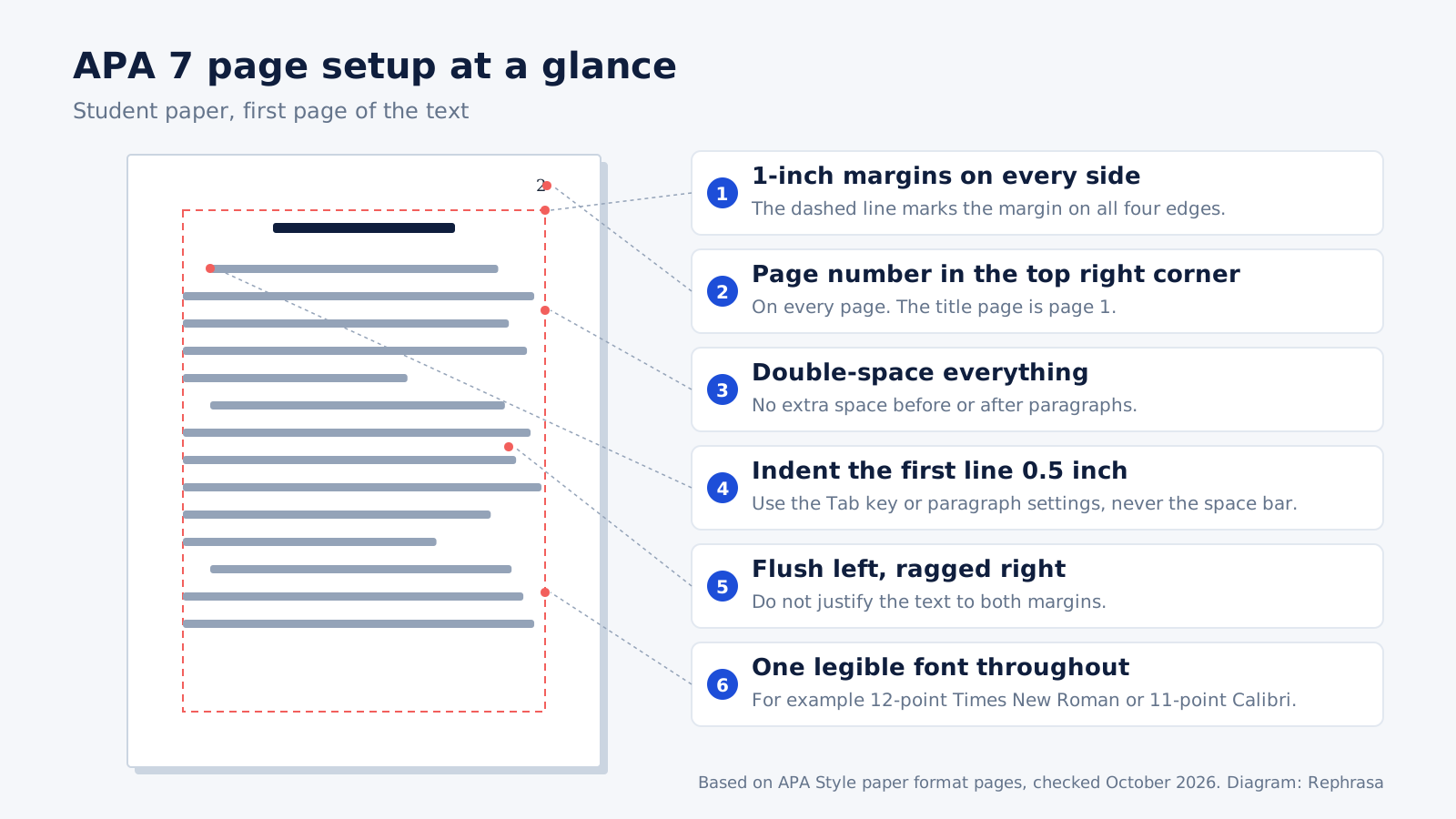
Page setup is the part of APA standard format that Word and Google Docs defaults already get close to. Here are the rules:
| Setting | APA 7 rule |
|---|---|
| Font | Any legible font used throughout, for example 12-point Aptos, 11-point Calibri, 11-point Arial, 10-point Lucida Sans Unicode, 12-point Times New Roman, 11-point Georgia, or 10-point Computer Modern |
| Margins | 1 inch on every side |
| Line spacing | Double-space everything, including the abstract, block quotations and the reference list; no extra space before or after paragraphs |
| Alignment | Flush left with a ragged right edge; no full justification |
| Paragraph indent | First line indented 0.5 inch with the Tab key or paragraph settings, never the space bar |
| Page numbers | Top right corner of every page; the title page is page 1 |
| Running head | Professional papers only (unless your instructor asks), all capitals, 50 characters or fewer |
Font: you have more choice than you think
Times New Roman is not required. The APA font page lists sans serif and serif options and now includes 12-point Aptos. The only firm rule is to use the same font throughout, with exceptions for figure images, computer code and footnotes. APA also recommends judging length by word count rather than page count, because fonts take up different amounts of space. Our take: if you get a page limit, ask whether a word count is acceptable instead.
Margins, spacing and alignment
Use 1-inch margins on all sides. Double-space all parts of the paper; exceptions include table cells, figure images and footnotes. Align text to the left margin and leave the right edge uneven.
Page header
For students, the page header is just the page number in the top right corner. Professional papers add a running head: a shortened title in capital letters, aligned left, with no "Running head:" label in front of it.
Student vs professional title page
APA 7 has two title page versions; students use the student one unless told otherwise. Both start the title three to four lines down, centered and bold, with one double-spaced blank line before the author names, as described on the APA title page setup page.
| Element | Student title page | Professional title page |
|---|---|---|
| Paper title (bold, centered, title case) | Yes | Yes |
| Author names (byline) | Yes | Yes |
| Affiliation | Department and university you attend | Institution where the research was done |
| Course number and name | Yes, for example PSY 201: Introduction to Psychology | No |
| Instructor name | Yes | No |
| Assignment due date | Yes, in your country's usual date format | No |
| Author note | No (unless requested) | Yes, bottom half, label "Author Note" bold and centered |
| Running head | No (unless requested) | Yes |
| Page number 1 | Yes | Yes |
With two authors, join the names with "and". With three or more, separate them with commas and put "and" before the last name. We cover each element with a worked layout in our guide to the APA title page.
The five APA heading levels
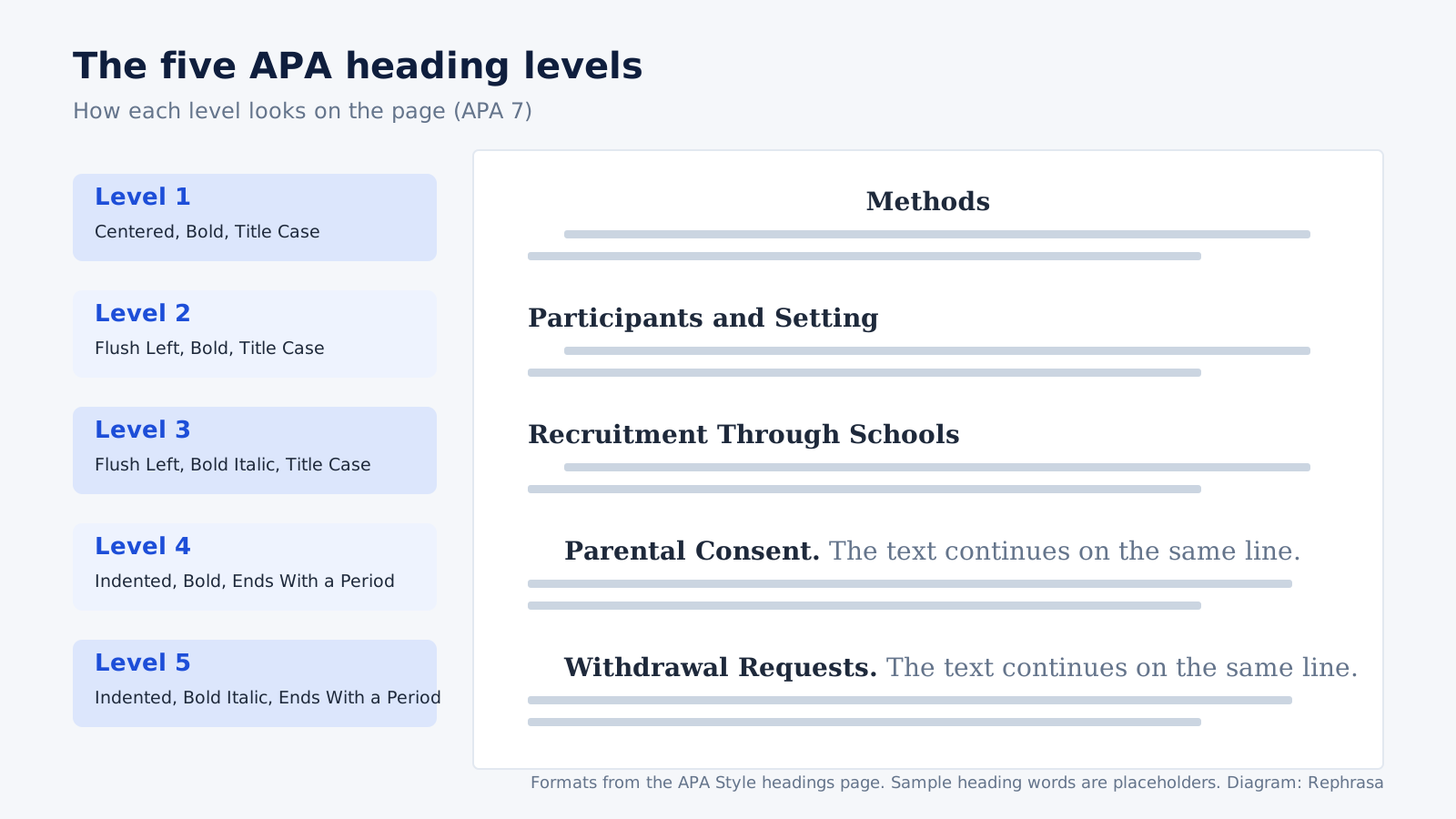
APA uses five heading levels, and you only use as many as your paper needs. A short essay may need none at all. According to the APA headings page, the formats are:
| Level | Format | Where the text starts |
|---|---|---|
| 1 | Centered, Bold, Title Case | New indented paragraph |
| 2 | Flush Left, Bold, Title Case | New indented paragraph |
| 3 | Flush Left, Bold Italic, Title Case | New indented paragraph |
| 4 | Indented, Bold, Title Case, Ending With a Period. | Same line as the heading |
| 5 | Indented, Bold Italic, Title Case, Ending With a Period. | Same line as the heading |
Three rules catch people out: no "Introduction" heading (the paper title already acts as Level 1), no numbers or letters on headings, and no section with only one subheading.
Tip: use your word processor's heading styles instead of bolding by hand; APA notes this helps screen reader users too.
In-text citation basics
APA uses an author-date system: every source you use appears once in the text as a short citation and once in the reference list as a full entry. The two citation formats are parenthetical, where the name and year sit in parentheses, and narrative, where the name is part of your sentence.
- Parenthetical: Falsely balanced news coverage can distort the public's perception of expert consensus on an issue (Koehler, 2016).
- Narrative: Koehler (2016) noted the dangers of falsely balanced news coverage.
The number of authors changes the format. These examples come from the APA author-date page:
| Author type | Parenthetical | Narrative |
|---|---|---|
| One author | (Luna, 2020) | Luna (2020) |
| Two authors | (Salas & D'Agostino, 2020) | Salas and D'Agostino (2020) |
| Three or more authors | (Martin et al., 2020) | Martin et al. (2020) |
| Group author, first use | (National Institute of Mental Health [NIMH], 2020) | National Institute of Mental Health (NIMH, 2020) |
| Group author, later uses | (NIMH, 2020) | NIMH (2020) |
Use "&" inside parentheses and "and" in running text. Use only the year, even if the reference has a full date, and write "n.d." when there is no date. APA does not use "ibid."; you repeat the full citation each time.
Paraphrasing does not remove the need to cite. APA's paraphrasing guidance says that when you restate an idea in your own words, you still cite the original work, and a page number is optional but helpful for long sources. That applies whether you reword a passage yourself or draft it with a tool such as our academic paraphrasing tool. For quotes, page numbers, secondary sources and every author combination, read our full guide to APA in-text citations, or compare APA with other styles in what an in-text citation is.
Reference list rules with four examples
The reference list setup page sets these rules:
- Start the list on a new page after the text, with the label References bold and centered. Not "Works Cited" or "Bibliography".
- Alphabetize by the first word of each entry, usually the first author's surname. A work with no author is alphabetized by its title.
- Apply a 0.5-inch hanging indent and double-space the whole list, with no extra space between entries.
- Every work cited in the text must appear in the list, and every entry must be cited in the text. Personal communications are the main exception: they appear in the text only.
Each entry answers four questions, according to APA's basic principles: who (author), when (date), what (title) and where (source). A period follows each element, except after a DOI or URL. In the author element, list surnames and initials for up to 20 authors; with 21 or more, give the first 19, an ellipsis, then the final author. Leave out the publisher location.
Below are four common source types, each copied from the official example page. The italics match the official examples; in your paper, each entry also gets the hanging indent.
Journal article
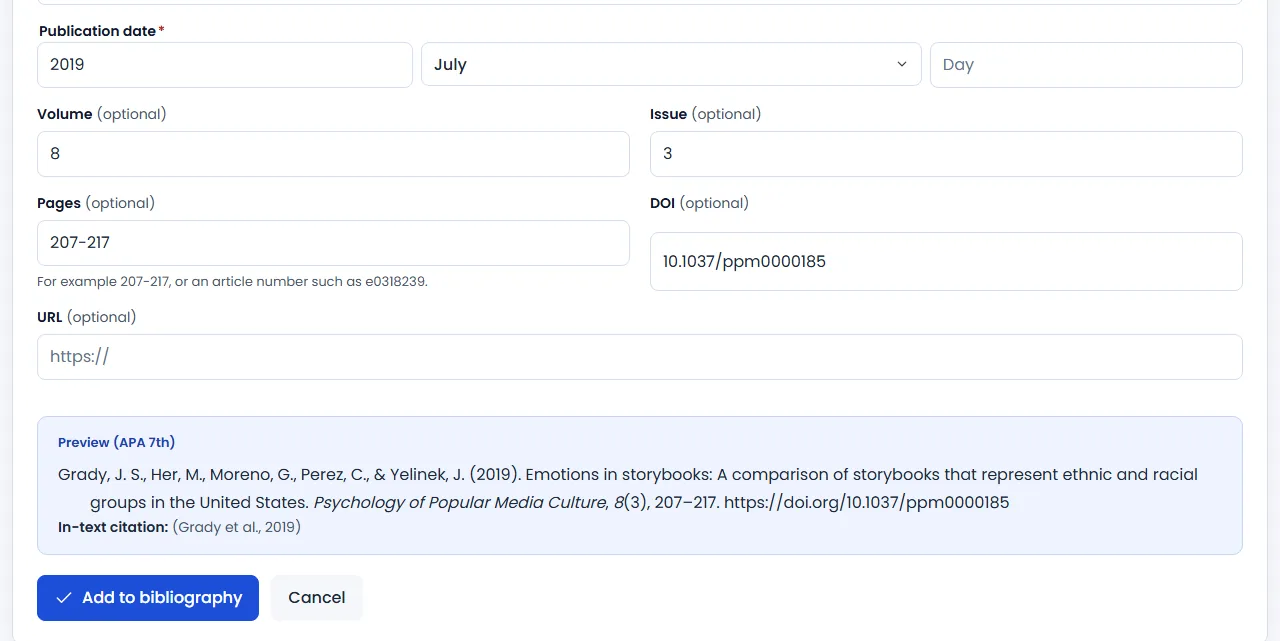
Grady, J. S., Her, M., Moreno, G., Perez, C., & Yelinek, J. (2019). Emotions in storybooks: A comparison of storybooks that represent ethnic and racial groups in the United States. Psychology of Popular Media Culture, 8(3), 207-217. https://doi.org/10.1037/ppm0000185
The article title is in sentence case with no italics; the journal name and volume number are italic; the issue number sits in parentheses right after the volume. Source: APA journal article references. In the text this is (Grady et al., 2019).
Book
Sapolsky, R. M. (2017). Behave: The biology of humans at our best and worst. Penguin Books.
A book that stands alone has an italic title in sentence case, then the publisher, with no city. Source: APA book references.
Webpage on a website
Schaeffer, K. (2021, October 1). What we know about online learning and the homework gap amid the pandemic. Pew Research Center. https://www.pewresearch.org/fact-tank/2021/10/01/what-we-know-about-online-learning-and-the-homework-gap-amid-the-pandemic/
Webpages use the full date if shown, an italic title, the site name and the URL. Source: APA webpage references.
Chapter in an edited book
Aron, L., Botella, M., & Lubart, T. (2019). Culinary arts: Talent and their development. In R. F. Subotnik, P. Olszewski-Kubilius, & F. C. Worrell (Eds.), The psychology of high performance: Developing human potential into domain-specific talent (pp. 345-359). American Psychological Association. https://doi.org/10.1037/0000120-016
The chapter title is plain, editor initials come first, and the italic book title is followed by the page range. Source: APA edited book chapter references.
Hand-typed entries are where most errors creep in. Our APA citation generator builds the entry from a DOI, URL or ISBN; you can also go straight to citing a journal article, citing a book or citing a website. Whatever tool you use, check the result against the source, because publisher metadata is sometimes incomplete.
APA 7 vs APA 6: what changed
If an older handout shows a different APA standard format, it may follow the sixth edition. APA's own guide to what is new in the seventh edition lists the changes. These are the ones you are most likely to notice:
| Topic | APA 6 | APA 7 |
|---|---|---|
| Three or more authors in text | Smith, Ellenio, and Pruitt (2019) at first citation, Smith et al. (2019) after | Smith et al. (2019) every time, including the first |
| Publisher location | Washington, DC: SAGE. | SAGE. |
| DOI | Label "DOI:" could be used | Written as a link starting https://doi.org/, no label |
| URLs | "Retrieved from" before URLs | "Retrieved from" only when a retrieval date is needed |
| Author is also publisher | "Author." in the source position | Publisher left out |
| Running head | "Running head:" label on the first page | No label; not required on student papers |
| Student title page | One title page format | Separate student version with course, instructor and due date |
| Authors listed in a reference | A different limit (changed in APA 7) | Up to 20 names |
| Fonts | Less flexible font guidance | Several accessible fonts allowed |
All section labels, such as "Abstract" and "References", are also bold now. If your department still requires APA 6, follow it, but confirm that the requirement is current before you format a whole paper the old way.
Common APA formatting mistakes
These slips are easy to check against the rules above:
- Labelling the list "Bibliography" or "Works Cited" instead of "References".
- Adding a running head and the "Running head:" label to a student paper.
- Using title case for article and book titles in the reference list. APA uses sentence case there.
- Indenting reference entries normally instead of with a hanging indent.
- Adding blank lines between paragraphs or around headings.
- Listing all authors of a three-author work in the first in-text citation, the old APA 6 habit.
- Citing a source in the text that never appears in the reference list, or the other way round.
- Paraphrasing a source without a citation because the words are now your own.
Honestly, the last one matters most. Formatting errors cost points; a missing citation can raise an integrity question. When unsure, cite.
A final APA format checklist
Before you submit, run through this APA standard format checklist. Each line maps to a rule covered above:
- One legible font, 1-inch margins, double spacing, page numbers top right.
- Correct title page version (student or professional).
- Headings bold, never numbered, with no "Introduction" heading.
- References on a new page, alphabetized, double-spaced, hanging indent, DOIs as https://doi.org/ links.
If you want to compare your layout with a finished example, APA publishes annotated student and professional sample papers as PDF and Word files. And when you are building your reference list, the Rephrasa citation generator formats APA 7 entries in your browser for free, ready to copy into your paper. If you are writing an annotated reference list instead, see our guide to the annotated bibliography.
Frequently asked questions
Is APA format the same as APA style?
Mostly, yes. APA Style is the full set of guidelines in the Publication Manual, covering writing, bias-free language, tables, citations and references. People usually say APA format when they mean the paper layout and citation part of APA Style: font, margins, spacing, title page, headings, in-text citations and the reference list.
What font and size does APA 7 require?
No single font is required. APA lists options such as 12-point Aptos, 11-point Calibri, 11-point Arial, 10-point Lucida Sans Unicode, 12-point Times New Roman, 11-point Georgia and 10-point Computer Modern. Use the same font throughout the paper.
Do student papers need a running head in APA 7?
No. Student papers have only a page number in the page header unless the instructor or institution asks for a running head. Professional papers include a running head in capital letters with no "Running head:" label.
Does a student APA paper need an abstract?
Usually not. APA says student papers generally do not include an abstract unless the assignment requests one. A title page, the text and references are the parts every paper needs.
Do I need to cite a source if I paraphrase it?
Yes. APA says to cite the original work whenever you paraphrase, using a narrative or parenthetical citation. Rewording a passage, by hand or with a paraphrasing tool, changes the words but not who the idea belongs to.
How many authors do I list in an APA 7 reference?
List surnames and initials for up to 20 authors. For 21 or more, list the first 19, add an ellipsis, then the final author. In the text, a work with three or more authors is cited with the first author and et al. from the first citation.
What changed from APA 6 to APA 7?
The changes students notice most: three or more authors are cited as the first surname plus et al. from the first citation, the publisher location is left out, DOIs are written as https://doi.org/ links without a label, student papers get their own title page and no running head, a reference can list up to 20 authors, and more fonts are allowed. If your department still requires APA 6, follow it.
Sources
- APA Style: Paper format
- APA Style: Order of pages
- APA Style: Font
- APA Style: Margins
- APA Style: Line spacing
- APA Style: Paragraph alignment and indentation
- APA Style: Page header
- APA Style: Title page setup
- APA Style: Headings
- APA Style: Parenthetical versus narrative in-text citations
- APA Style: Author-date citation system
- APA Style: Paraphrases
- APA Style: Reference list setup
- APA Style: Basic principles of reference list entries
- APA Style: Elements of reference list entries
- APA Style: Journal article references
- APA Style: Book references
- APA Style: Webpage on a website references
- APA Style: Chapter in an edited book references
- APA: Guide to what is new in the Publication Manual, Seventh Edition (PDF)
- APA Style: Sample papers
- APA Style: About APA Style
- APA: Publication Manual of the American Psychological Association, Seventh Edition