
MLA In-Text Citation: Rules and Examples (9th Edition)
Show contents
- The author-page format in MLA
- MLA citation in text for one, two, or three or more authors
- MLA in-text citation with no author
- No page numbers and how to cite a website in text in MLA
- Quotes and block quotes in MLA
- Citing the same source twice or across a paragraph
- Matching your in-text citations to the Works Cited page
- Why paraphrases need an MLA citation too
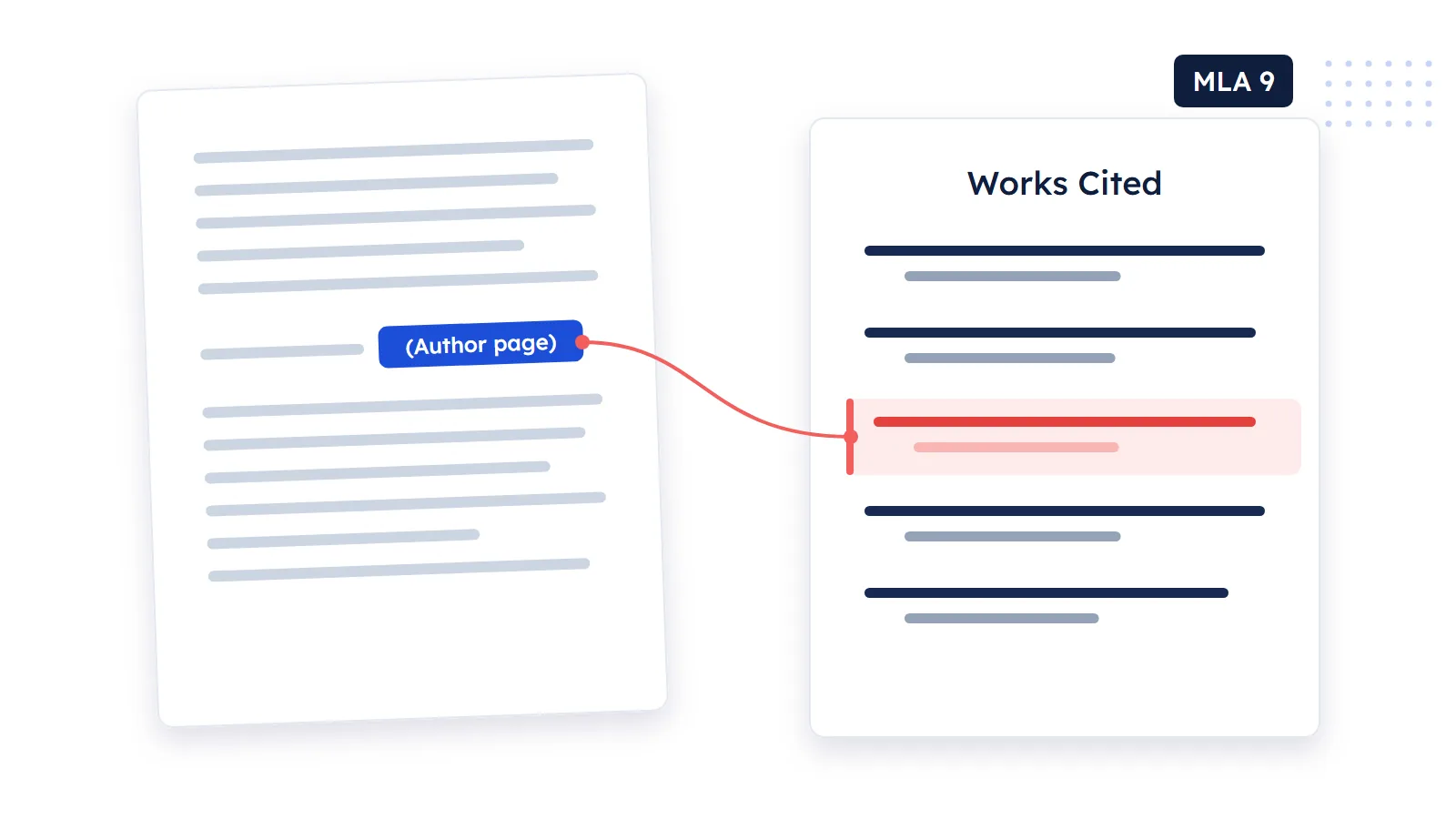
An MLA in text citation is a short reference inside your sentence that points to one entry on your Works Cited page. In the ninth edition of MLA style, it usually holds the author's last name and a page number in parentheses, with no comma between them: (Wordsworth 263). If you name the author in your sentence, the parentheses keep only the page number.
That is the whole core rule. The rest of this guide covers the cases that trip people up: two authors, three or more, no author, no page numbers, websites, long quotations, and citing the same source again. Every rule below is checked against the MLA Style Center or the Purdue OWL, and each example comes from those pages.
The author-page format in MLA
MLA uses what the Purdue OWL calls the author-page method. The author's last name and the page you took the idea or words from must appear in your text. The name can sit in your sentence or in the parentheses. The page number always goes in the parentheses, never in the sentence itself.
Here are the three standard patterns from the Purdue OWL guide to MLA in-text citations:
- Author in the sentence: Wordsworth stated that Romantic poetry was marked by a "spontaneous overflow of powerful feelings" (263).
- Author in parentheses: Romantic poetry is characterized by the "spontaneous overflow of powerful feelings" (Wordsworth 263).
- Paraphrase with the author named: Wordsworth extensively explored the role of emotion in the creative process (263).
The MLA itself adds one rule that many students break: do not give the author's name in both places. "According to Naomi Baron, reading is 'just half of literacy' (Baron 194)" repeats the name. The correct version ends with (194) only. We think this is the single easiest fix in most first drafts, because it costs nothing and makes your prose read cleaner.
Notice also what is missing. MLA in-text citations carry no year, no "p." before the page, and no comma after the author. If you are used to APA, compare this with our guide to APA in-text citation rules, where the year is required.
MLA citation in text for one, two, or three or more authors
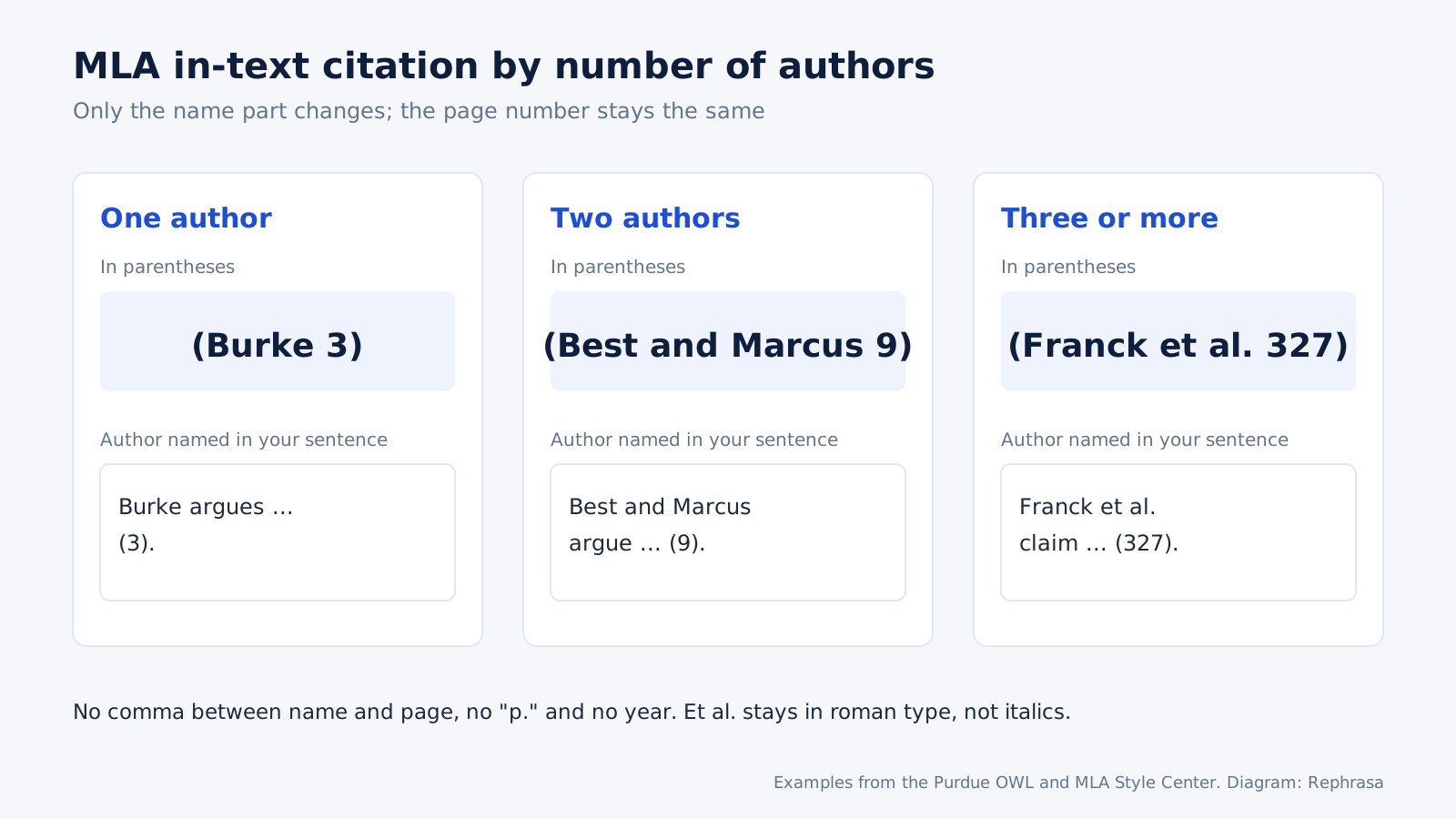
The number of authors changes only how the name part looks. The page part stays the same.
One author
Use the last name: Human beings have been described as "symbol-using animals" (Burke 3). The matching Works Cited entry must begin with Burke, because the in-text citation has to lead the reader straight to it.
Two authors
Give both last names joined by "and": The authors claim that surface reading looks at what is "evident, perceptible, apprehensible in texts" (Best and Marcus 9). In your sentence you can write "Best and Marcus argue..." and keep only (9) in the parentheses.
Three or more authors: et al.
Give the first author's last name followed by et al., which means "and others": (Franck et al. 327). In a signal phrase you may write "According to Franck et al." The MLA notes that if you name the collaborators in your prose, you may list every name or write the first name followed by "and others" or "and colleagues."
Two small style points. Et al. is set in roman type, not italics, in parenthetical citations (MLA Style Center).
| Situation | Parenthetical citation | Name in your sentence |
|---|---|---|
| One author | (Burke 3) | Burke argues ... (3). |
| Two authors | (Best and Marcus 9) | Best and Marcus argue ... (9). |
| Three or more authors | (Franck et al. 327) | Franck et al. claim ... (327). |
| No author, short work | ("Impact of Global Warming") | The article "The Impact of Global Warming in North America" notes ... |
| Two works by one author | (Elkins, "Visual Studies" 63) | Elkins argues in "Visual Studies" ... (63). |
| Authors with the same last name | (R. Miller 12) | R. Miller claims ... (12). |
| Whole work or no page numbers | (Baron) | Naomi Baron broke new ground on the subject. |
| Two sources at once | (Burke 3; Dewey 21) | Not usually written in prose |
| Source quoted in another source | (qtd. in Weisman 259) | Ravitch argues ... (qtd. in Weisman 259). |
MLA in-text citation with no author
When a source has no author, the Works Cited entry starts with the title, so the in-text citation uses the title too. Shorten it to a noun phrase and drop opening articles: To the Lighthouse becomes Lighthouse. Put the short title in quotation marks for a short work such as an article or web page, and in italics for a long work such as a book or a whole website.
The Purdue OWL example cites an unsigned article like this: ... "more comprehensive programs to monitor and study environmental change . . ." ("Impact of Global Warming"). The full title, "The Impact of Global Warming in North America," starts the matching Works Cited entry.
Two rules keep this tidy. First, the short title must start with the same word the entry starts with (ignoring "A," "An," and "The"), otherwise readers cannot find it in an alphabetical list. Second, the MLA says no ellipsis is added when you shorten a title in a citation.
A corporate author, such as an agency or company, counts as an author. Use the organization's name, shortened where MLA abbreviations allow, so a long name does not interrupt your sentence.
No page numbers and how to cite a website in text in MLA
Many web pages, online articles, and e-books have no fixed page numbers. The MLA asks for a location marker only when the work has one, so in that case, and when you refer to a work as a whole, the citation holds only the name or title that starts the Works Cited entry: At least one researcher has broken new ground on the subject (Baron). If you name the author in your sentence, you may need no parentheses at all.
For a website, the Purdue OWL gives three practical rules:
- Start with the first item in the Works Cited entry: the author, or the article or page title if there is no author.
- Do not invent page or paragraph numbers from your browser's print preview.
- Do not put URLs in the text. A site name that contains a domain, such as CNN.com, is fine as a name.
So an in-text citation for a web page with an author looks like (Taylor), or (Taylor, "Fitzcarraldo") when you cite two works by that writer. Without an author it becomes the short title in quotation marks. One honest warning: some instructors ask for paragraph numbers anyway. The MLA has said that adapting to a professor's instructions works, so check your assignment brief before you follow the default.
If the online version has no pages but the database gives the page range of the print original, the MLA puts that range in the Works Cited entry only. The in-text citation still carries no page number, because the version you quoted has none (MLA Style Center).
Videos, films, and podcasts are different. They have a runtime, so you give a time range instead of a page, for example (00:02:15-00:02:35). Our website citation generator builds the matching Works Cited entry from a URL, so the first word of your in-text citation and the entry line up.
Quotes and block quotes in MLA
Short quotations
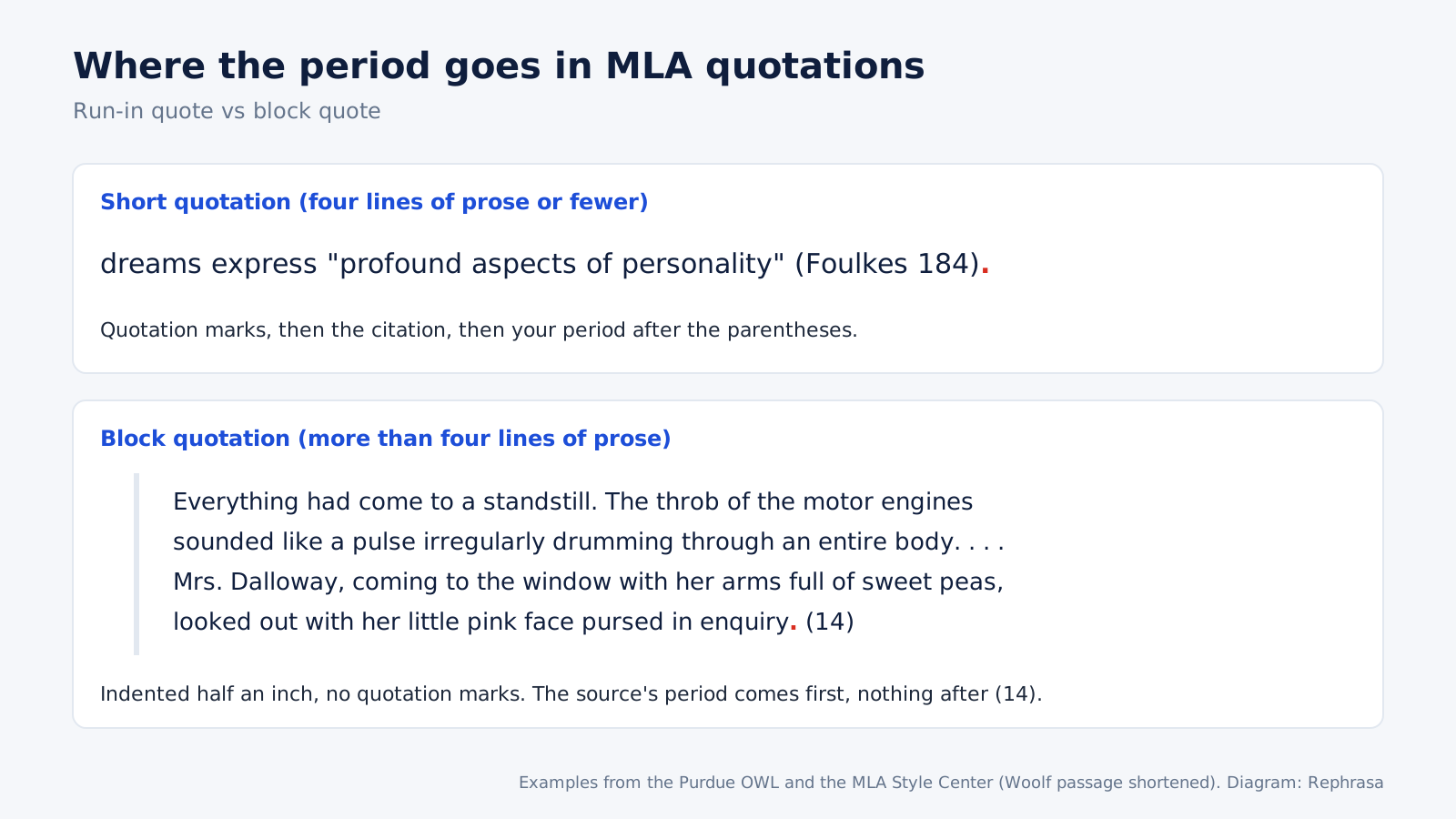
A short quotation is four typed lines or fewer of prose, or three lines or fewer of verse. Put it in double quotation marks and place the citation after the closing quotation mark. The sentence's period, comma, or semicolon comes after the parentheses: dreams express "profound aspects of personality" (Foulkes 184), though others disagree.
Question marks and exclamation points that belong to the quote stay inside the quotation marks. If the question is yours, the mark goes after the citation: Is it possible that dreams may express "profound aspects of personality" (Foulkes 184)?
Block quotations
A quotation longer than four lines of prose, or three lines of verse, becomes a block. Start it on a new line, indent the whole passage half an inch from the left margin, keep double spacing, and drop the quotation marks (Purdue OWL).
Everything had come to a standstill. The throb of the motor engines sounded like a pulse irregularly drumming through an entire body. . . . Mrs. Dalloway, coming to the window with her arms full of sweet peas, looked out with her little pink face pursed in enquiry. (14)
This Virginia Woolf example comes from the MLA Style Center, shortened here. The punctuation is the reverse of a short quote: the citation comes after the final period, and no period follows the parentheses. The MLA explains the logic. In a run-in quote your own sentence ends with the citation, so your period follows it. In a block, readers already know the sentence ends there, so the source's own period is kept instead.
Our view: block quotes are overused in student essays. If a passage needs more than four lines, ask whether a paraphrase would show your understanding better. A paraphrase still needs the same citation, which our guide on how to paraphrase explains step by step.
Citing the same source twice or across a paragraph
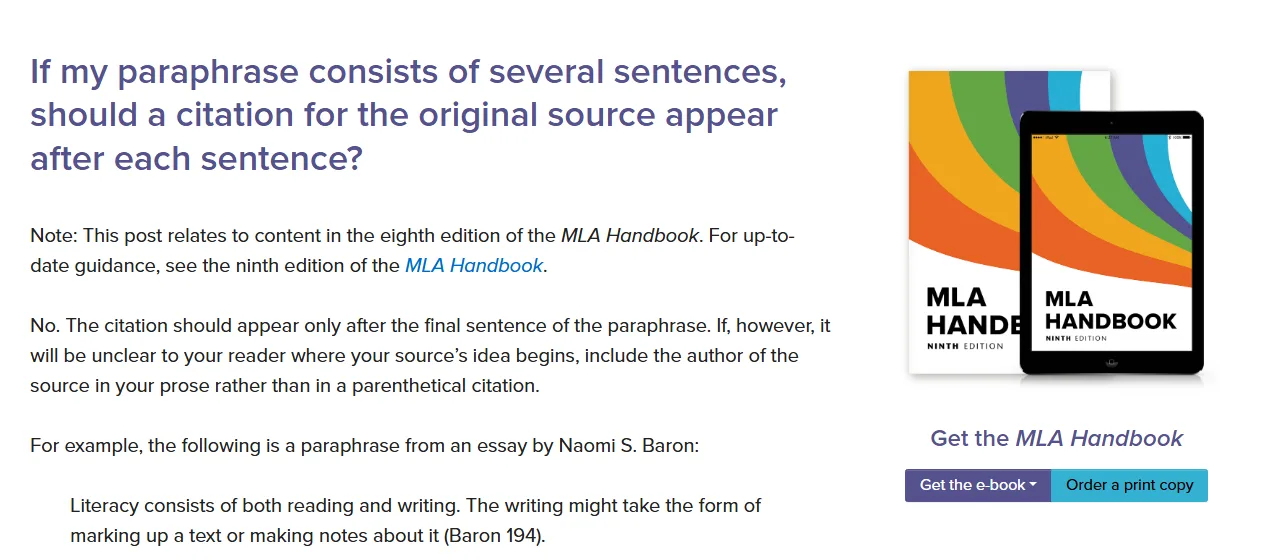
You do not need a citation after every sentence of a paraphrase. The MLA advises one citation after the final sentence of the borrowed material. If readers might not see where the source's idea begins, name the author at the start instead: Naomi S. Baron argues that literacy consists of both reading and writing. The writing might take the form of marking up a text or making notes about it (194).
When the same source continues into the next paragraph and no other source comes in between, the MLA says you need not name it again unless that would cause confusion. In practice, we suggest repeating at least the page number whenever the page changes. A reader who checks your work wants the exact location, not just the book.
Other cases from the Purdue OWL that look like repeats but are not:
- Two works by one author: add a short title, as in ("Too Soon" 38) and ("Hand-Eye Development" 17).
- Two authors with the same surname: add first initials, as in (R. Miller 12) and (A. Miller 46).
- Same lead author, different coauthors: the MLA uses a short title after et al., as in (Taylor et al., "Collaboration").
- Two sources for one point: separate them with a semicolon, as in (Burke 3; Dewey 21).
Matching your in-text citations to the Works Cited page
An in-text citation is only half of the system. The MLA describes it as the shortest piece of information that directs readers to the entry in the works-cited list. So whatever word starts your citation, a surname or a title, must be the first word at the left margin of one entry.
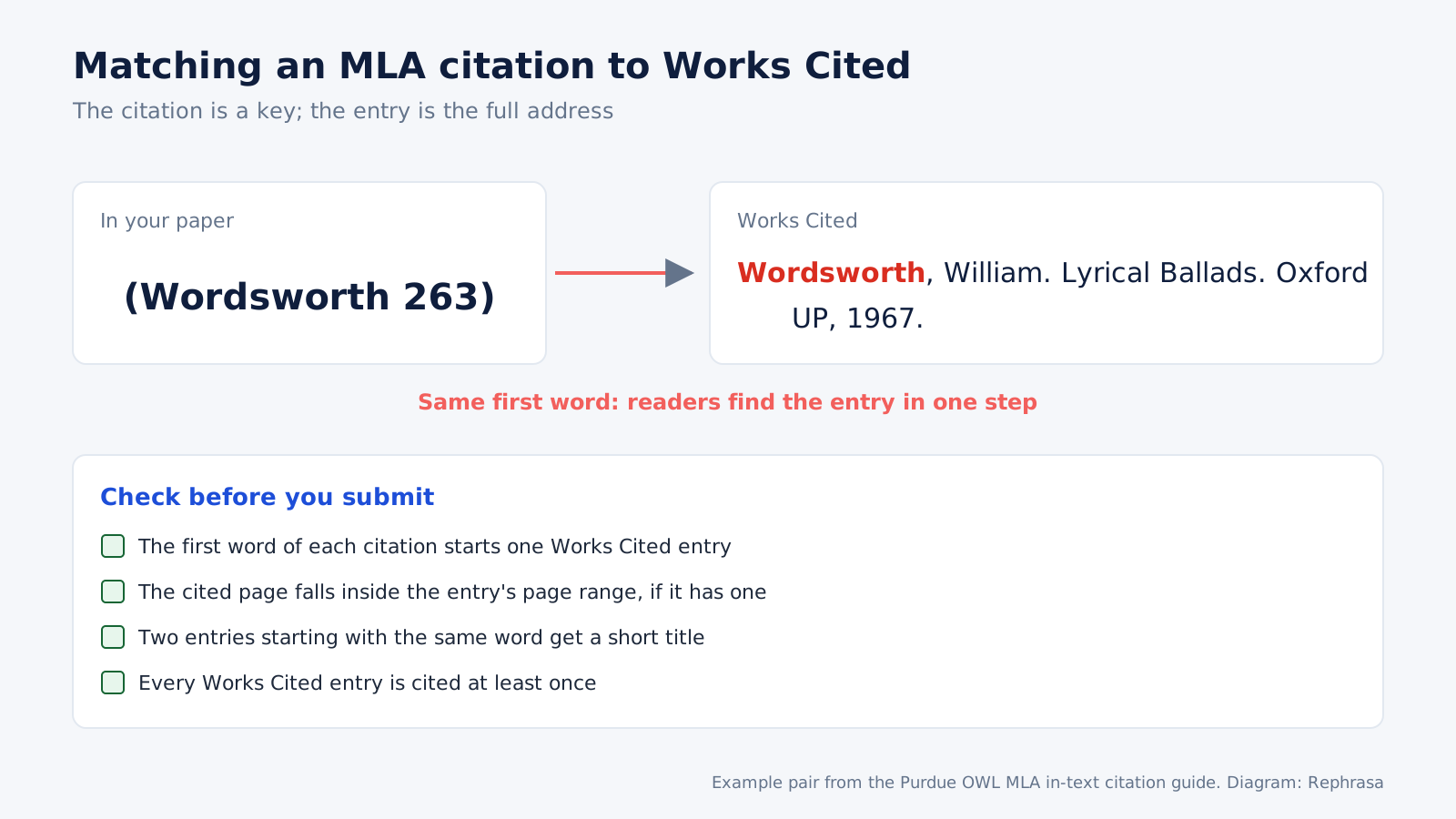
Before you submit, run this check on every citation:
- Find the first word of the citation in your alphabetical Works Cited list.
- Confirm the entry exists and starts with that exact name or title.
- Check that the page you cite falls inside the page range of the entry, if it has one.
- Make sure two entries never share the same starting word without a short title to tell them apart.
- Delete any Works Cited entry that no citation points to.
Here is the pair the Purdue OWL uses. The citation (Wordsworth 263) points to: Wordsworth, William. Lyrical Ballads. Oxford UP, 1967. The entry begins with the same surname, so readers find it in one step.
Building the entries by hand is where most errors come in. Our free MLA citation generator formats Works Cited entries in MLA 9 from a DOI, URL, or ISBN in your browser, and you can edit every field before adding it. For books, try the book citation generator, and for journal articles with a DOI, the DOI to citation tool. Always compare the result with the source itself, since metadata from publishers is sometimes incomplete.
Why paraphrases need an MLA citation too
A citation is not only for direct quotes. The MLA defines plagiarism as presenting another person's ideas, words, or entire work as your own, and it lists paraphrasing someone's ideas without proper credit as one form (MLA Style Center). Rewording a passage changes the words, not the owner of the idea.
That matters if you use a rewriting tool. Our academic paraphrasing tool can help you restate a source in clearer academic English, but the result still needs the same (Author page) citation as the original. Keep the source details while you work, and add the in-text citation and the Works Cited entry before you move on. For a side-by-side view of how MLA compares with APA, Chicago, Harvard, IEEE, and AMA, read our overview of in-text citation styles.
The short version of everything above: name, page, parentheses, no comma. Match the first word to your Works Cited list, and cite paraphrases as carefully as quotes.
Frequently asked questions
What is the basic MLA in-text citation format?
Give the author's last name and the page number in parentheses with no comma between them, for example (Burke 3). If you name the author in your sentence, put only the page number in the parentheses, for example (3).
How do you cite three or more authors in MLA in-text citations?
Write the first author's last name followed by et al. and the page number, for example (Franck et al. 327). Et al. is not italicized in parenthetical citations.
How do I cite a website in text in MLA with no page numbers?
Use the first item of the Works Cited entry, which is the author's last name or, without an author, a shortened title in quotation marks, for example (Taylor) or ("Impact of Global Warming"). Do not add page numbers from a print preview and do not put the URL in the citation.
Where does the period go with an MLA block quote?
In a block quotation the source's own period stays at the end of the passage and the parenthetical citation follows it, with no period after the parentheses. In a short quotation the period comes after the parentheses instead.
Do I need an MLA in-text citation for a paraphrase?
Yes. The MLA counts paraphrasing someone's ideas without proper credit as plagiarism, so a paraphrase needs the same author and page citation as a direct quote, placed after the last sentence of the borrowed material.
How do you cite two authors in an MLA in-text citation?
Give both last names joined by "and", followed by the page number, for example (Best and Marcus 9). If you name both authors in your sentence, the parentheses hold only the page number.
How do you cite a source with no author in MLA?
Use a shortened version of the title that starts the Works Cited entry, in quotation marks for a short work such as an article or web page and in italics for a long work such as a book, for example ("Impact of Global Warming"). Drop opening articles such as A, An and The.
How do I cite two sources for the same point in MLA?
Put both citations in one set of parentheses and separate them with a semicolon, for example (Burke 3; Dewey 21).
Sources
- MLA Style Center: In-Text Citations: An Overview
- Purdue OWL: MLA In-Text Citations: The Basics
- Purdue OWL: MLA Formatting Quotations
- MLA Style Center: Positioning a parenthetical citation with run-in and block quotations
- MLA Style Center: Should et al. be italicized in MLA style?
- MLA Style Center: Same lead author, different coauthors
- MLA Style Center: Citing a paraphrase of several sentences
- MLA Style Center: Citing the same source in more than one paragraph
- MLA Style Center: Online articles without page numbers
- MLA Style Center: Plagiarism and Academic Dishonesty