
In-Text Citation: What It Is and How to Write One in Any Style
Show contents
- What is an in-text citation?
- Parenthetical vs narrative citations
- In-text citation examples in six styles
- When do you need an in-text citation?
- In-text citation after a quote and with page numbers
- How to do an in-text citation for a website
- Multiple sources and secondary sources
- Common in-text citation mistakes
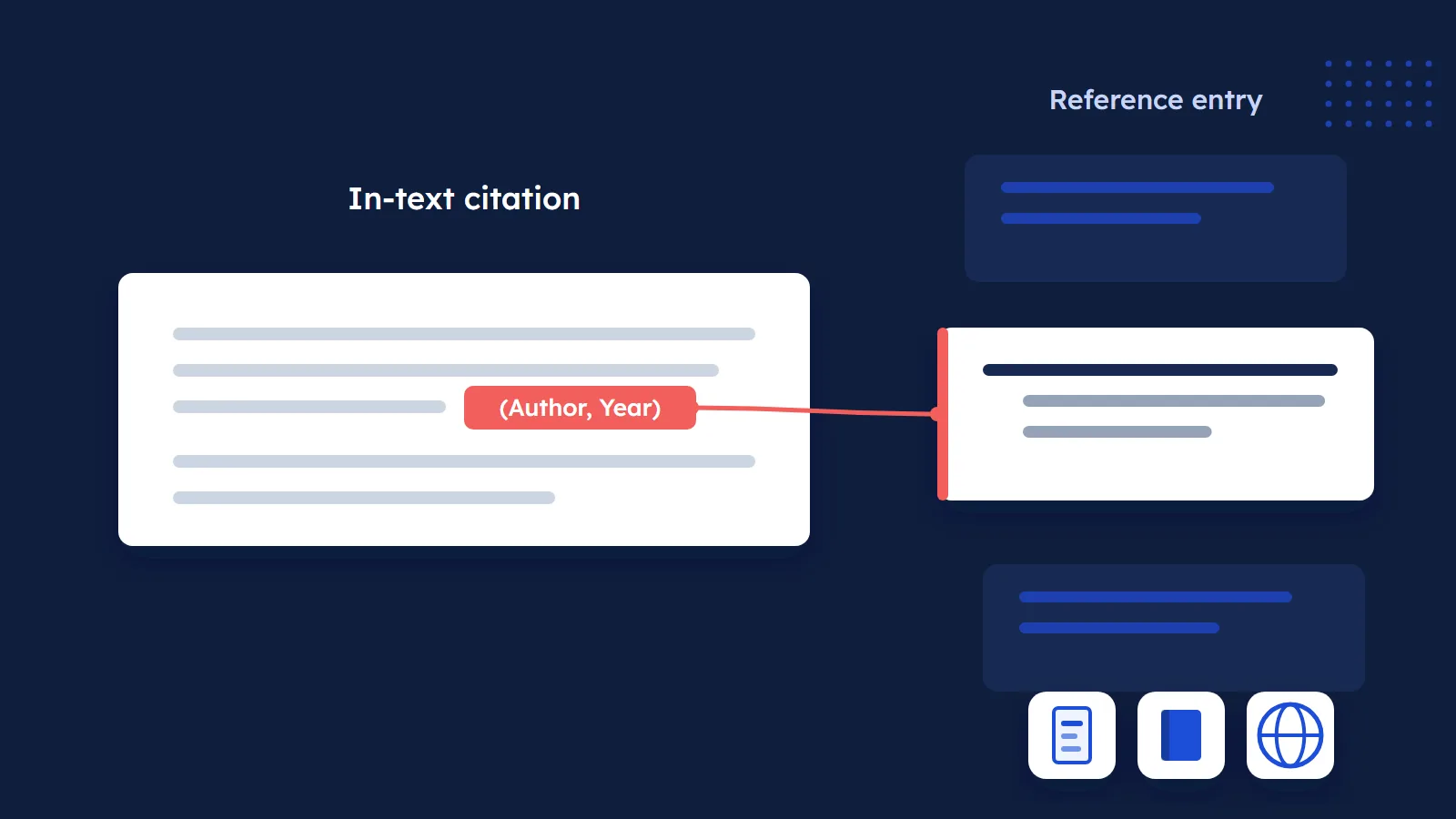
An in-text citation is a short reference inside your sentence, such as (Luna, 2020) or [1], that tells the reader which source an idea, quote or number came from. It points to the full entry in your reference list, works cited page or bibliography. You need one every time you quote, paraphrase or use data from someone else.
Every major style uses one, but each writes it differently. Below you will find what an in-text citation is for, the two basic formats, a side-by-side table for APA, MLA, Chicago, Harvard, IEEE and AMA, and the most common mistakes. Every rule here was checked against the official style guide or a university library guide that follows it.
What is an in-text citation?
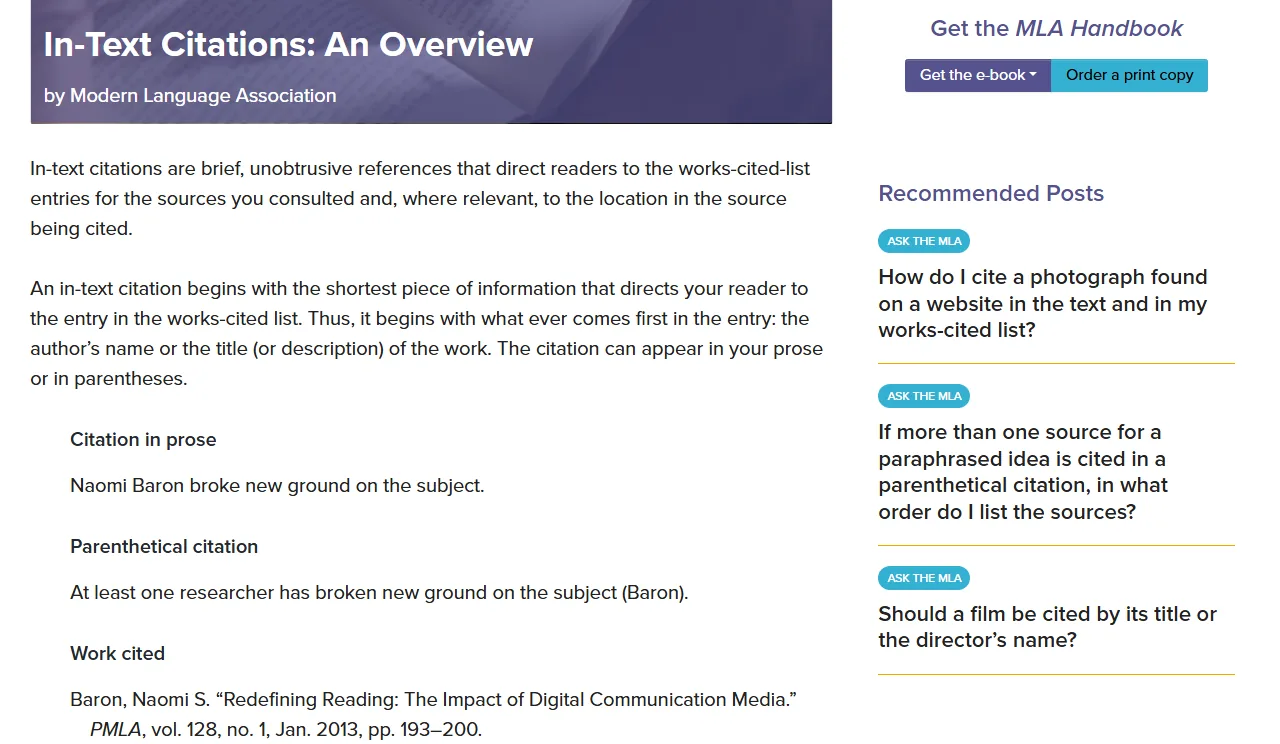
The MLA Style Center describes in-text citations as "brief, unobtrusive references" that direct readers to the works-cited entries for the sources you consulted. That definition works for every style, not only MLA.
An in-text citation has two jobs:
- Credit. It shows which words, ideas or findings belong to another author, so your own contribution is clear.
- Navigation. It gives the reader just enough information (a name and a year, a name and a page, or a number) to find the full reference at the end of the paper.
That is why the in-text citation and the reference list must match. APA puts it plainly: each in-text citation must correspond to only one reference list entry, and the year in the text must match the year in that entry.
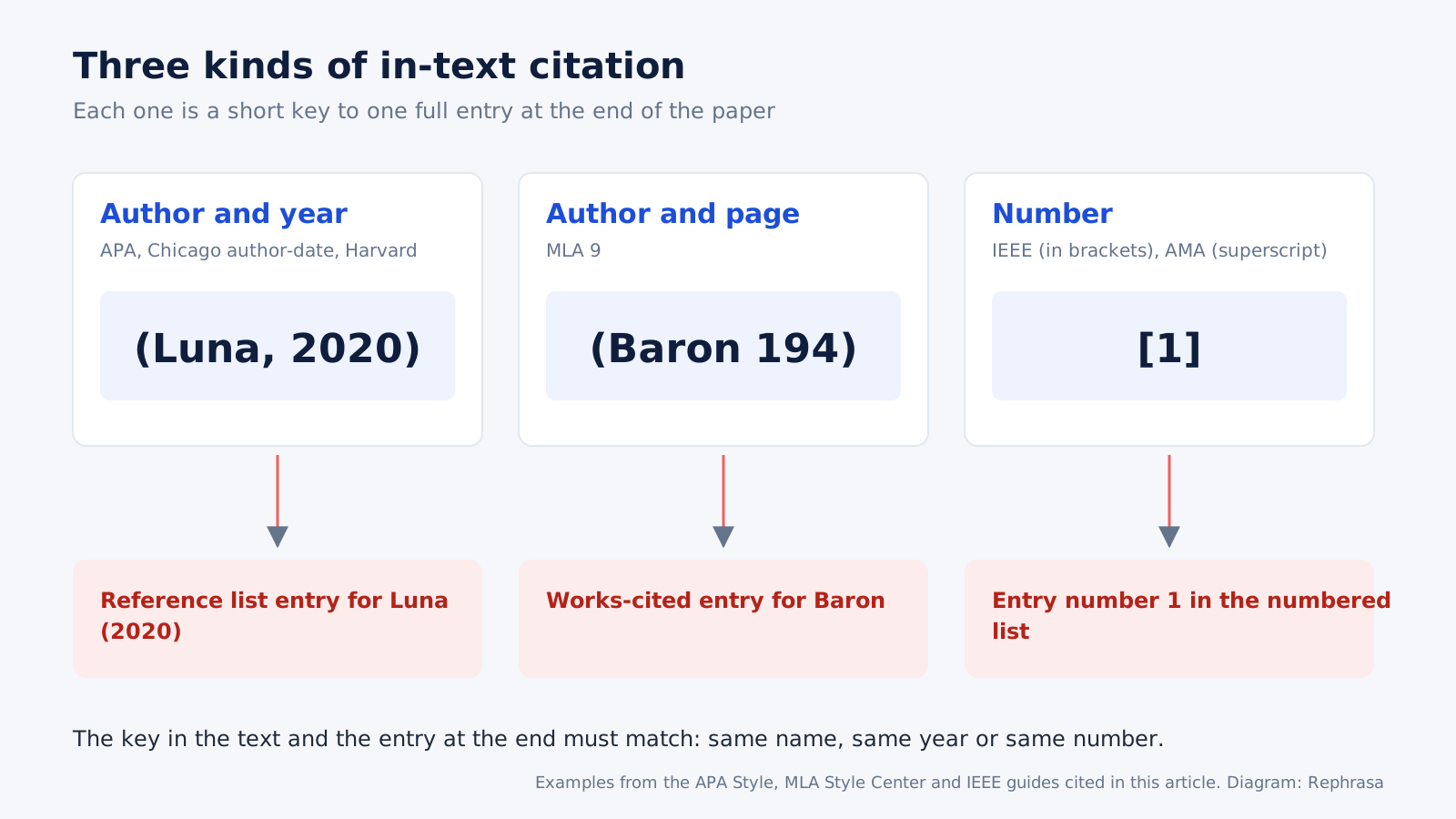
Think of the in-text citation as the shortest possible key to the full record. Styles differ mainly in the key they choose. Author-date styles (APA, Chicago author-date, Harvard) use the author and year. MLA uses the author and page. Numbered styles (IEEE, AMA) use a number.
Parenthetical vs narrative citations
There are two ways to place an in-text citation in a sentence, and most styles allow both.
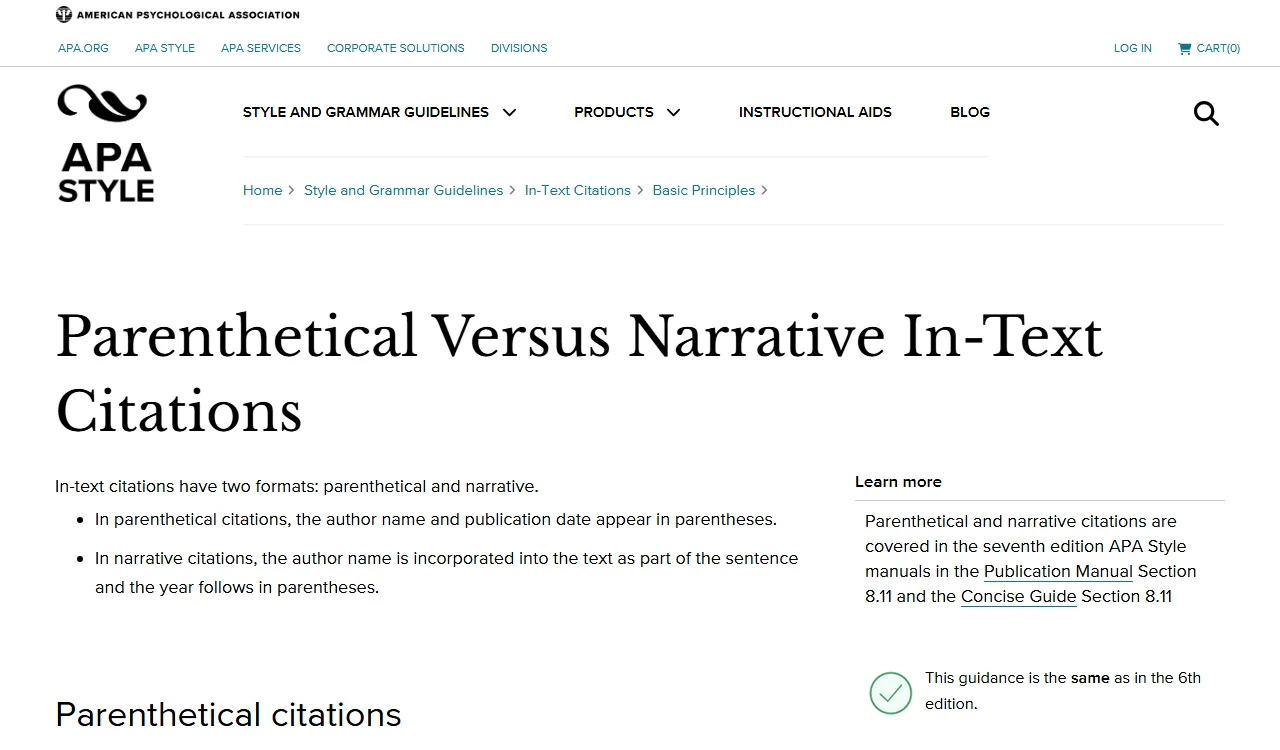
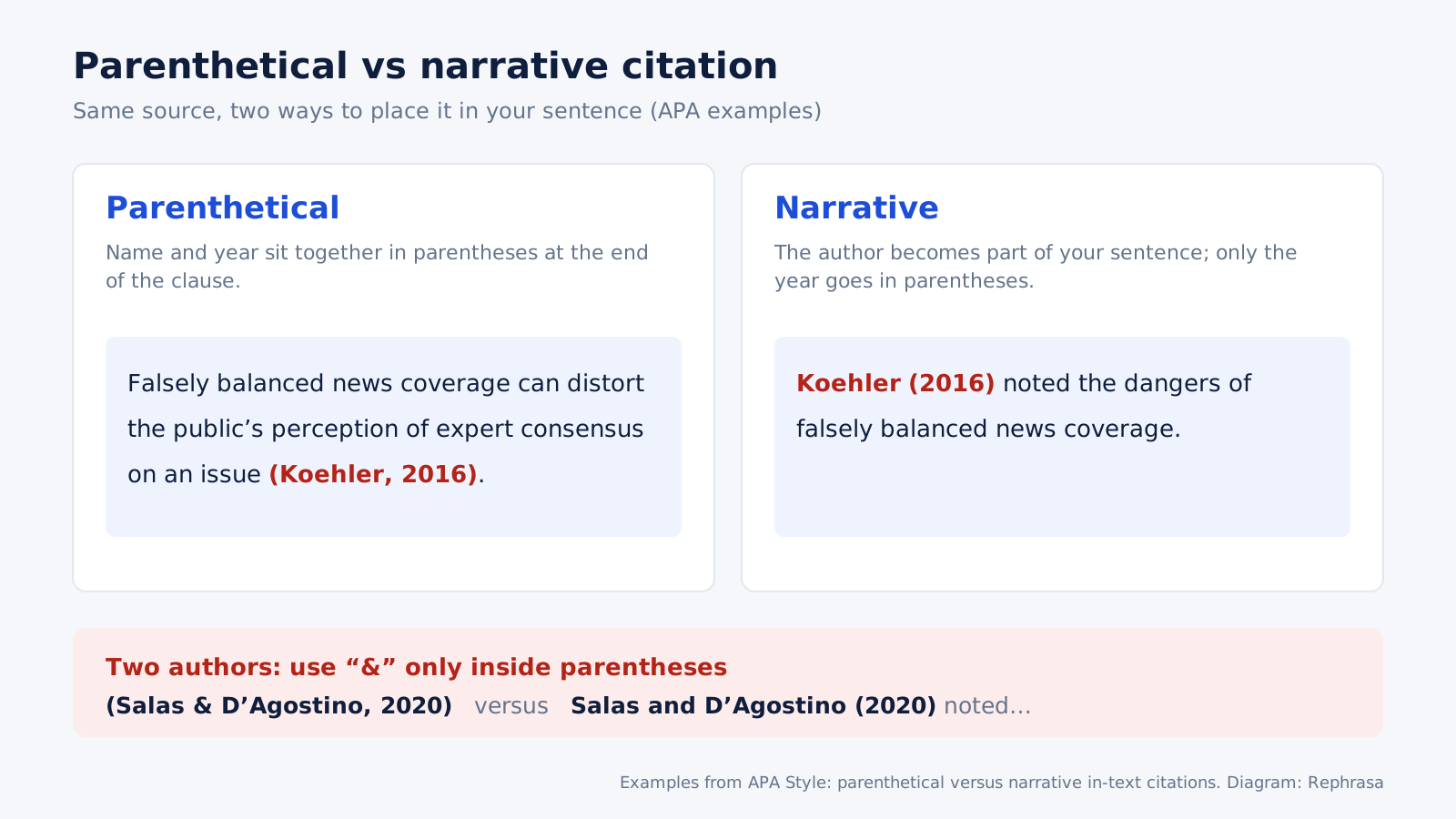
A parenthetical citation puts the citation details in brackets, usually at the end of the clause or sentence. A narrative citation makes the author part of your sentence. The APA Style guidance on parenthetical and narrative citations gives this pair:
Parenthetical: Falsely balanced news coverage can distort the public's perception of expert consensus on an issue (Koehler, 2016).
Narrative: Koehler (2016) noted the dangers of falsely balanced news coverage.
MLA works the same way. In prose you might write "Naomi Baron broke new ground on the subject." In parentheses you would write "At least one researcher has broken new ground on the subject (Baron)." Both forms lead to the same works-cited entry.
Which one should you use? Our view: choose by emphasis, not by habit. Use a narrative citation when the author matters to your argument, for example when you compare two researchers or disagree with one. Use a parenthetical citation when the finding matters more than who found it.
One small but common slip: in a narrative citation the author's name sits in your sentence, so you do not repeat it in the parentheses. APA writes "Salas and D'Agostino (2020)" in narrative form but "(Salas & D'Agostino, 2020)" in parentheses, with the ampersand only inside the brackets.
In-text citation examples in six styles
This table puts the same situations side by side. Each example is taken from the official guide or the library guide listed under Sources.
| Style | One author | Two authors | Three or more | With a page or location |
|---|---|---|---|---|
| APA 7 | (Luna, 2020) | (Salas & D'Agostino, 2020) | (Martin et al., 2020) | (Ervin et al., 2018, p. 470) |
| MLA 9 | (Baron 194) | (Best and Marcus 9) | (Franck et al. 327) | (Wordsworth 263) |
| Chicago author-date | (Yu 2020, 45) | (Dittmar and Schemske 2023, 480) | (Snyder et al. 2025, 9-10) | (Kwon 2022, 1842-43) |
| Harvard (Cite Them Right) | (Ashbourn, 2014) | (Thomas and Tian, 2021) | Three: (Adeyeye, Ashaolu and Idowu-Adebayo, 2022). Four or more: (Moise et al., 2020) | (Singh, Khurana and Singh, 2018, p.35) |
| IEEE | [1] | Brown and Jones [5] | Wood et al. [7] | [3, pp. 5-10] |
| AMA 11 | Superscript number: ...colon cancer.1 | Smith and Doe14 reported... | First author + et al, with the number | Not covered in the guide we used |
Two details trip people up. APA and Harvard put a comma between author and year, while Chicago author-date does not. MLA has no year at all, because the year lives in the works-cited entry.
APA 7
APA uses author and year. One or two authors are always named; three or more become the first surname plus "et al." from the first citation. Group authors can be abbreviated after the first use, for example "(National Institute of Mental Health [NIMH], 2020)" and then "(NIMH, 2020)". Works with no date use "n.d.", and works with no author use the title and year. For the full rule set, read our guide to APA in-text citation rules or format a source with the APA citation generator.
MLA 9
MLA uses the author-page method. According to the Purdue OWL summary of MLA in-text citations, the author's name can go in the sentence or the parentheses, but the page number always goes in the parentheses. There is no comma and no "p." between name and page. A source with no known author is cited by a shortened title. Our MLA in-text citation guide covers block quotes and repeated sources, and the MLA citation generator builds the works-cited entry that your citation points to.
Chicago author-date
The Chicago author-date quick guide (18th edition) shows author, year and page with no comma after the name: "(Yu 2020, 45)". For three or more authors, list only the first in the text, followed by "et al." If a web page has no date, Chicago uses "n.d." in place of the year. Note that Chicago also has a notes and bibliography system that uses footnotes instead of parentheses; the Chicago citation generator supports both.
Harvard
"Harvard" is a family of similar author-date styles rather than one fixed standard. One widely used version is Cite Them Right, which the University of Reading library guide uses for its examples. In that version you name up to three authors in the text and switch to "et al." from four authors. Always check which Harvard variant your department expects. Our Harvard referencing guide compares it with APA, and the Harvard referencing generator uses the Cite Them Right rules.
IEEE
IEEE replaces names with numbers in square brackets. The IEEE Reference Guide says the brackets sit on the line, inside the punctuation, and can be read like nouns: "as demonstrated in [2]". The guide also says ranges are written out, so "[1]-[4]" becomes "[1], [2], [3], [4]". To point to a page, add it inside the bracket: "[3, pp. 5-10]". The IEEE citation generator numbers your list for you.
AMA
AMA, common in medicine and health sciences, uses superscript Arabic numerals. The Augusta University AMA 11th edition guide explains that references are numbered in the order they are first cited, and the number sits right next to the fact or quote it supports. Several sources at one point are separated by commas with no spaces, and consecutive numbers use a hyphen, for example 3-10 or 2,9-11,16. You can create the matching list with the AMA citation generator.
When do you need an in-text citation?
The short answer: whenever the reader could reasonably ask "where did this come from?" APA's page on the appropriate level of citation lists the situations that need credit:
- You paraphrase, meaning you state someone else's idea in your own words.
- You quote someone's exact words.
- You refer to data or a data set.
- You reprint or adapt a table or figure, including Creative Commons images from the internet.
- You reprint a long passage of text or a commercially copyrighted test item.
The first item surprises many students. A paraphrase is still someone else's idea, so it still needs a citation, even if not a single word matches the original. APA's paraphrasing guidance says to cite the original work in narrative or parenthetical form whenever you paraphrase. Rewording a source, by hand or with a tool, changes the wording, not the ownership of the idea. If you want to practise, our guide on how to paraphrase walks through a full example, and the academic paraphrasing tool is set up to leave citations such as "(Smith, 2020)" unchanged while it rewrites.
The opposite mistake also exists. APA calls it overcitation: repeating the same citation in every sentence when the source has not changed. If one paragraph paraphrases one source across several sentences, cite it in the first sentence and again only if you switch sources or start a new paragraph.
In-text citation after a quote and with page numbers
Quotes have stricter rules than paraphrases, mainly about location. The APA quotation guidelines require a full citation in the same sentence as a direct quote, including the page number or other location such as a paragraph number. The citation can sit right after the quote or at the end of the sentence, and the sentence's full stop goes after the closing parenthesis:
Effective teams can be difficult to describe because "high performance along one domain does not translate to high performance along another" (Ervin et al., 2018, p. 470).
Quotes of 40 words or more become block quotations in APA. These have no quotation marks, and the citation goes after the final punctuation with no extra full stop.
For paraphrases, page numbers are optional in APA. You may add one when it helps the reader find a passage in a long work, such as a book. MLA is stricter: when you quote or paraphrase a specific part of a work that has page numbers, line numbers or time stamps, that location marker must appear in the parentheses.
Here is how the same quote-with-page looks across styles:
- APA: (Ervin et al., 2018, p. 470)
- MLA: (Baron 194)
- Chicago author-date: (Lindquist 2023, 230)
- IEEE: [3, pp. 5-10]
How to do an in-text citation for a website
Websites cause the most questions because they often lack an author, a date or page numbers. The good news is that the in-text citation for a website follows the same logic as any other source: use whatever comes first in the reference entry.
- Author is an organization. Use the organization as the author: "(Stanford University, 2020)" in APA, "(Google 2023)" in Chicago author-date.
- No author. APA uses the title and year. MLA uses a shortened title, in quotation marks for a short work such as a web page article.
- No date. APA and Chicago author-date both use "n.d." in place of the year.
- No page numbers. MLA citations for web pages often need no page number. The Purdue OWL adds a useful warning: do not invent page numbers from your browser's print preview. In APA, give another location, such as a paragraph number, when you quote.
- No URL in the text. For MLA, the Purdue OWL advises against URLs in your sentence unless the site name itself is a domain, such as CNN.com. The full URL belongs in the reference entry.
In practice, the hardest part is rarely the format. It is finding the real author and date on the page. Check the byline and footer before you settle for "n.d.". Our guide to citing a website shows where these details usually hide.
Multiple sources and secondary sources
When one sentence draws on several works, APA puts them in one set of parentheses, in alphabetical order, separated by semicolons. The APA page on citing multiple works gives "(Adams et al., 2019; Shumway & Shulman, 2015; Westinghouse, 2017)". Numbered styles list the numbers instead, such as [2], [4], [5] in IEEE.
A secondary source is a work you know only through another author. APA's rule on secondary sources is to name the original and add "as cited in" the work you actually read: "(Rabbitt, 1982, as cited in Lyon et al., 2014)". Only the source you read goes in the reference list. Cite Them Right Harvard uses a similar form with "cited in". Use it sparingly: if the original is available, read and cite it directly.
Common in-text citation mistakes
These are the errors the official guides warn about most directly:
- Naming the author twice. MLA marks "According to Naomi Baron, reading is ... (Baron 194)" as incorrect. If the name is in your sentence, the parentheses hold only the page.
- Missing the page number on a direct quote. In APA and MLA, a quote without a location is incomplete.
- Using "ibid." APA does not use it. Repeat the full citation instead.
- Using "et al." too early or too late. APA uses it from three authors, Cite Them Right Harvard from four. Two authors are always both named.
- A citation with no matching reference. Every in-text citation needs exactly one entry in the list, with the same spelling and year.
- Mixing styles. A comma after the name in a Chicago author-date citation, or a year in an MLA citation, signals a mixed format.
- Forgetting to cite a paraphrase. New wording does not make the idea yours.
A contrarian note to finish: you do not need to memorize six styles. Learn the two families, author-date and numbered, and the logic of "shortest key to the full entry". The details for any one style are then a quick lookup. The Rephrasa citation generator formats the reference entry from a DOI, URL or ISBN and shows the matching in-text citation, so you can check your key against the full record before you submit.
Frequently asked questions
What is an in-text citation?
An in-text citation is a short reference inside your sentence, such as (Luna, 2020) in APA or [1] in IEEE, that shows which source an idea, quote or number came from and points the reader to the full entry in your reference list.
Do I need an in-text citation when I paraphrase?
Yes. A paraphrase restates someone else's idea in your own words, so the idea still belongs to the original author. APA, MLA and the other major styles all require a citation for paraphrased material, not only for direct quotes.
Where does the in-text citation go after a quote?
In APA, place the citation right after the quotation or at the end of the sentence, include the page number, and put the full stop after the closing parenthesis, for example (Ervin et al., 2018, p. 470). In MLA the page goes in parentheses after the quote, for example (Baron 194).
How do you do an in-text citation for a website with no author or date?
Use what comes first in the reference entry. With no author, APA uses the title and the year and MLA uses a shortened title. With no date, APA and Chicago author-date use n.d. in place of the year. Do not put the URL in your sentence.
When do you use et al. in an in-text citation?
It depends on the style. APA 7, MLA 9, Chicago author-date and IEEE use the first author plus et al. from three authors. Cite Them Right Harvard names up to three authors and uses et al. from four. Two authors are always both named.
What is the difference between an in-text citation and a reference list?
The in-text citation is the brief pointer inside your text. The reference list (works cited in MLA, bibliography in some styles) holds the full details of each source. Every in-text citation must match exactly one entry in that list.
What is the difference between a parenthetical and a narrative citation?
A parenthetical citation puts the author and year in parentheses, usually at the end of the clause: (Koehler, 2016). A narrative citation makes the author part of your sentence and only the year goes in parentheses: Koehler (2016) noted the dangers of falsely balanced news coverage. Both point to the same reference entry. In APA, use "&" only inside parentheses and "and" in running text.
Sources
- APA Style: Parenthetical versus narrative in-text citations
- APA Style: Author-date citation system
- APA Style: Quotations
- APA Style: Paraphrasing
- APA Style: Appropriate level of citation
- APA Style: Citing multiple works
- APA Style: Secondary sources
- MLA Style Center: In-text citations, an overview
- Purdue OWL: MLA in-text citations, the basics
- The Chicago Manual of Style: Author-date sample citations
- University of Reading Library: Cite Them Right Harvard citation examples
- IEEE Reference Guide
- Augusta University Libraries: AMA 11th citation guide