
How to Paraphrase: 6 Steps With Examples
Show contents
How to paraphrase, in one sentence: read the passage until you understand it, put it away, write the idea from memory in your own sentence structure, check your version against the original for accuracy, and cite the source. A paraphrase changes the words, but the idea still belongs to the original author.
This guide on how to paraphrase breaks the process into six steps, then works through a real passage from a NOAA article so you can see a weak, a wrong and a good paraphrase side by side. It also covers rewording single sentences, paraphrasing a quote, and citing your paraphrase in APA and MLA.
How to paraphrase in 6 steps
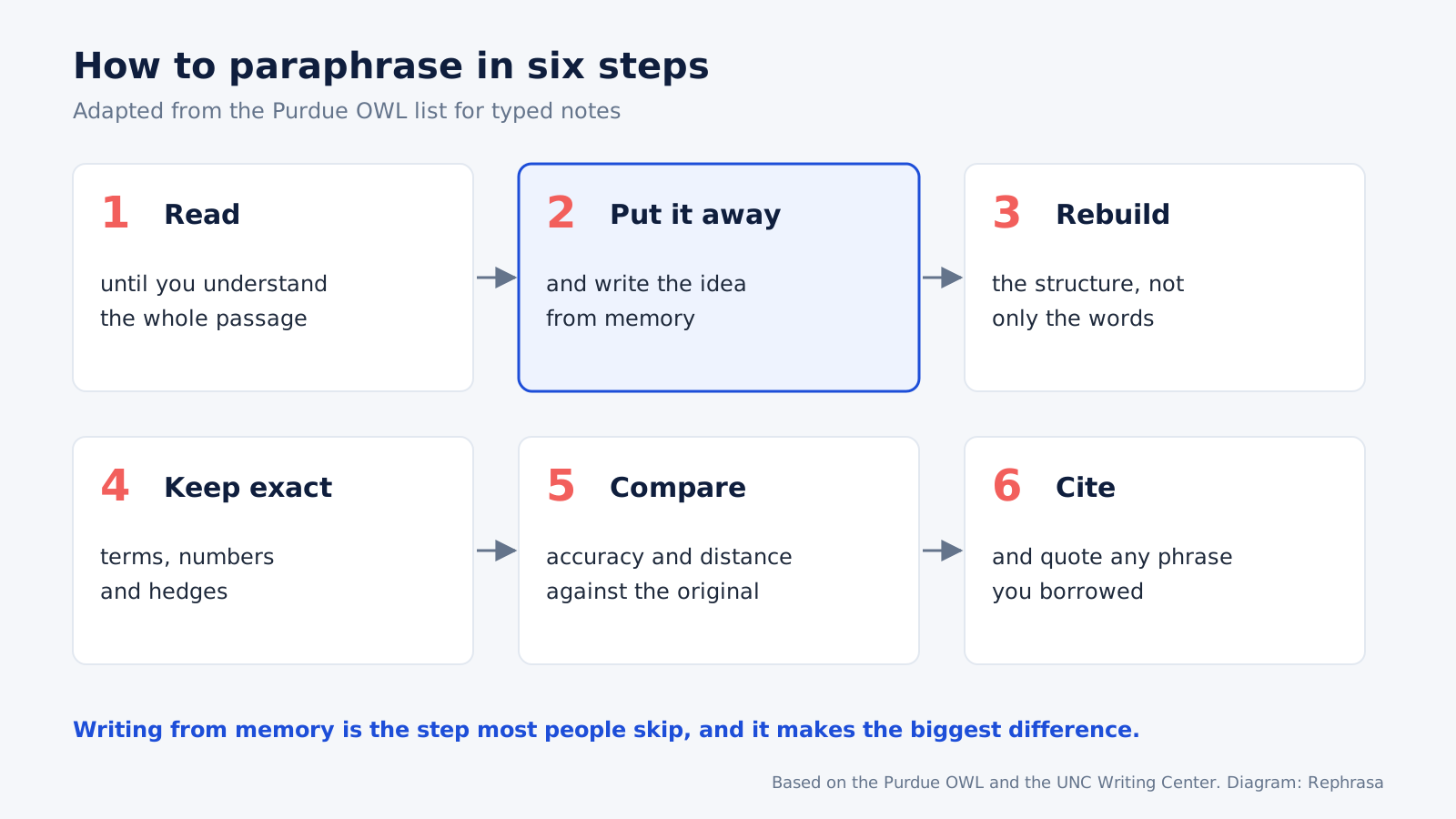
The Purdue OWL describes a paraphrase as "your own rendition of essential information and ideas expressed by someone else, presented in a new form" and lists six steps to effective paraphrasing. Our six steps adapt that list for typed notes rather than note cards.
- Read the passage until you understand its full meaning.
- Put the source away and write the idea from memory.
- Change the sentence structure, not only the words.
- Keep technical terms, numbers and hedges exact.
- Compare your version with the original.
- Cite the source, and quote any phrase you borrowed.
Read until you understand the whole passage
You cannot restate an idea you have not understood. Read the passage two or three times. Read the paragraphs around it too, since the point often depends on context.
A quick test: can you explain the passage to a classmate without looking at it? If you can only repeat the author's phrases, you are not ready yet.
Put the source away and write from memory
This step makes the biggest difference, and it is the easiest one to skip. The UNC Writing Center gives the same advice: to make sure you are really paraphrasing, take notes from your reading with the book closed.
With the original in view, your sentence tends to follow its order and rhythm. With it out of sight, you have to rebuild the idea yourself. If you are learning how to paraphrase, this habit matters more than any vocabulary trick.
Change the structure, not only the words
Swapping words for synonyms is a tempting shortcut, and it does not work. UNC is blunt about it: paraphrasing does not mean "changing a word or two in someone else's sentence, changing the sentence structure while maintaining the original words, or changing a few words to synonyms." That is plagiarizing, not paraphrasing.
A real paraphrase usually changes several things at once: the order of ideas, the subject of the sentence, active or passive voice, and how the clauses connect. The section on rephrasing a sentence below shows five ways to do this.
Keep technical terms, numbers and hedges exact
Not every word should change. Technical terms such as "carbon dioxide", "hydrogen ions" or "statistical significance" usually have no good synonym, and replacing them makes your writing less accurate. Keep them.
The same goes for numbers and for hedges, the small words that show how certain the author is: "about", "may", "primarily", "is associated with". In our view, hedges are where paraphrases go wrong most quietly. "Is associated with" turning into "causes" changes the claim, even if every other word is fine. If the author used a distinctive phrase that you want to keep, the Purdue OWL advises putting it in quotation marks.
Compare your version with the original
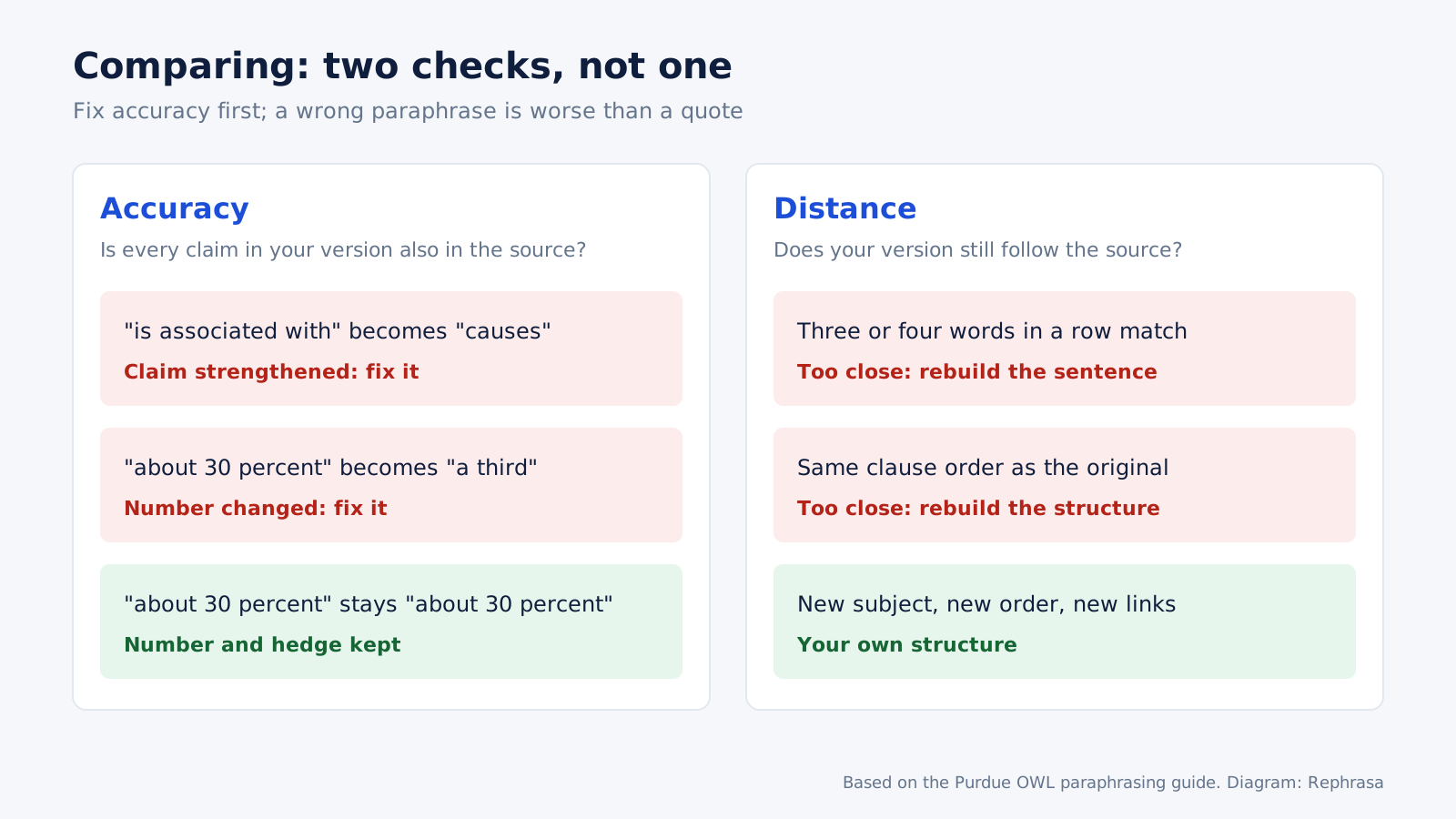
Now bring the source back. Purdue's guide says to check that your version "accurately expresses all the essential information in a new form". That is two checks, not one:
- Accuracy. Is every claim in your version also in the original? Did you add, drop or strengthen anything?
- Distance. Does any stretch of three or four words match the original exactly? Does your sentence follow the same order, clause by clause?
If the distance check fails, go back to the structure step. If the accuracy check fails, fix the meaning first; a paraphrase that sounds original but says something different is worse than a quote.
Cite the source
Every paraphrase needs a citation. APA puts it plainly: when you paraphrase, cite the original work using a narrative or parenthetical citation. The MLA lists "paraphrasing someone's ideas or arguments" without proper credit as a form of plagiarism. The details of each style are in the citation section below.
A worked example: paraphrasing a passage from an article
Here is how to paraphrase from an article in practice. The passage comes from the NOAA National Ocean Service page What is ocean acidification? (last updated September 23, 2026). It is a good test because it contains a number, technical terms and a chain of cause and effect.
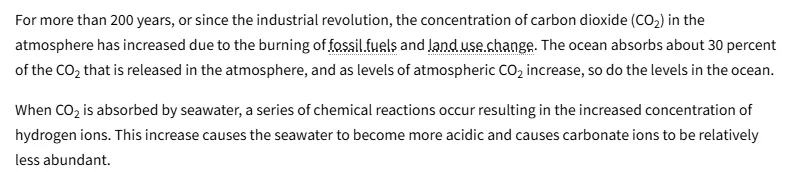
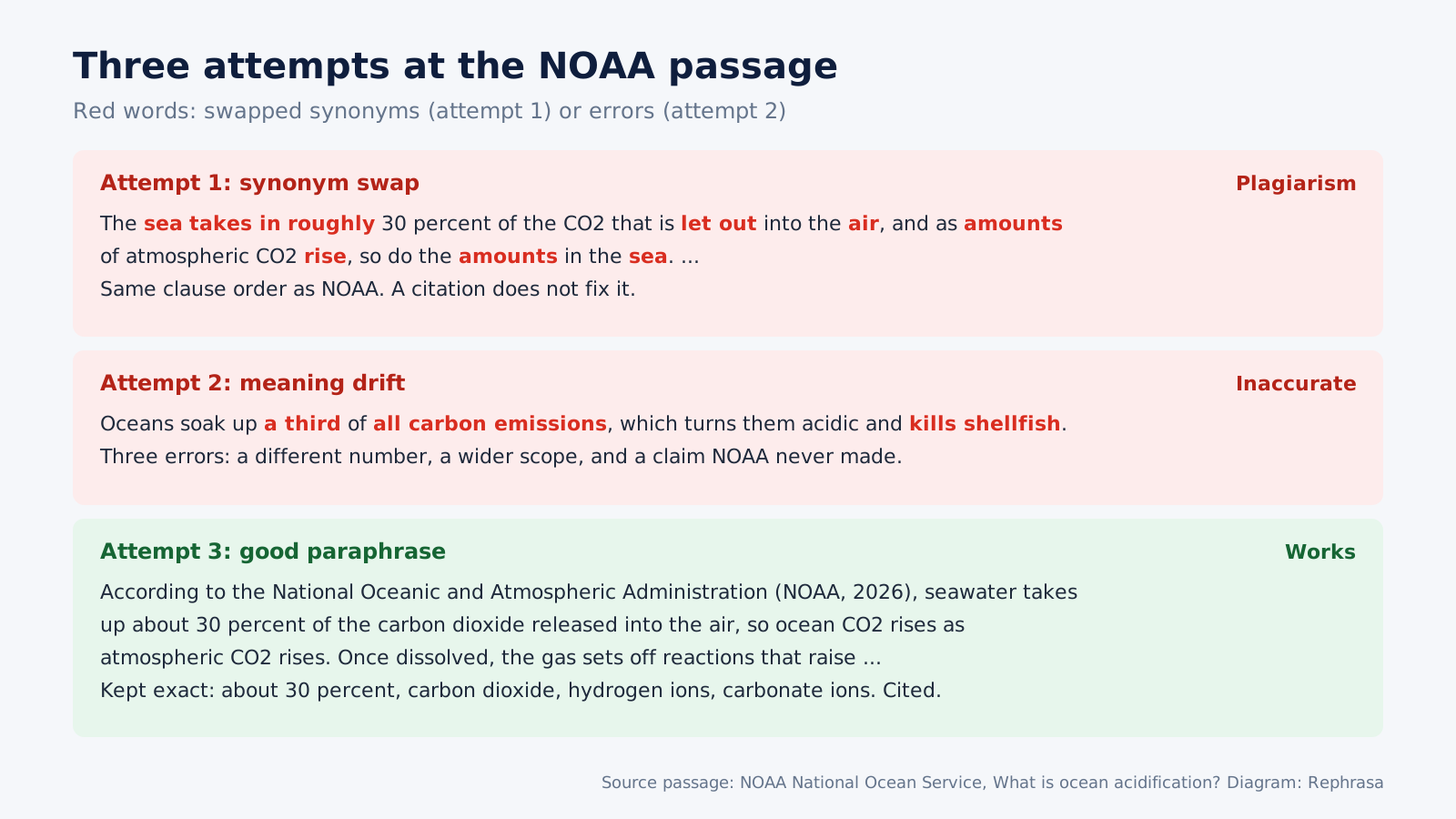
Original: "The ocean absorbs about 30 percent of the CO2 that is released in the atmosphere, and as levels of atmospheric CO2 increase, so do the levels in the ocean. When CO2 is absorbed by seawater, a series of chemical reactions occur resulting in the increased concentration of hydrogen ions. This increase causes the seawater to become more acidic and causes carbonate ions to be relatively less abundant."
Attempt 1: the synonym swap (plagiarism)
The sea takes in roughly 30 percent of the CO2 that is let out into the air, and as amounts of atmospheric CO2 rise, so do the amounts in the sea. When CO2 is taken in by seawater, a set of chemical reactions happen, leading to a higher concentration of hydrogen ions.
It follows the original clause by clause; only single words changed. This is what UNC calls plagiarizing, and a citation does not fix it, because the structure is still NOAA's.
Attempt 2: the meaning drift (inaccurate)
Oceans soak up a third of all carbon emissions, which turns them acidic and kills shellfish.
It sounds original, but it is wrong in three places. "About 30 percent" became "a third", which is a different number. "CO2 released in the atmosphere" became "all carbon emissions". And "kills shellfish" is not in the passage at all; NOAA says lower carbonate levels can make shell building difficult, which is a weaker claim.
Attempt 3: a good paraphrase
According to the National Oceanic and Atmospheric Administration (NOAA, 2026), seawater takes up about 30 percent of the carbon dioxide released into the air, so ocean CO2 rises as atmospheric CO2 rises. Once dissolved, the gas sets off reactions that raise the concentration of hydrogen ions; the water grows more acidic, and carbonate ions become relatively scarcer.
What changed: the subject (seawater instead of the ocean), the order (the source is named first), the link between sentences ("once dissolved") and most of the verbs. What stayed: the number, the hedge "about", and the technical terms "carbon dioxide", "hydrogen ions" and "carbonate ions". The citation is there, and the matching APA reference entry would be:
National Oceanic and Atmospheric Administration. (2026, September 23). What is ocean acidification? National Ocean Service. https://oceanservice.noaa.gov/facts/acidification.html
How to rephrase a sentence: five techniques
How to paraphrase a sentence works the same way, at a smaller scale. Most good rewrites combine two or three of these techniques. The sample sentences are illustrations written for this guide.
| Technique | Original | Rephrased |
|---|---|---|
| Change the subject | Researchers collected the samples in spring. | The samples were gathered in spring by the research team. |
| Switch active and passive voice | The survey was completed by 40 teachers. | Forty teachers completed the survey. |
| Change the word class | The policy had a significant effect on attendance. | The policy significantly affected attendance. |
| Split or combine sentences | The method is cheap, and it is also quick to learn. | The method costs little. It is also quick to learn. |
| Reorder the ideas | Because funding was cut, the project was delayed. | The project was delayed after its funding was cut. |
Notice that "40 teachers" stays 40, and "spring" stays spring. Rewording changes the shape of a sentence, never its facts.
One honest caveat: applied to someone else's sentence one by one, these techniques can still produce patchwriting (text that keeps the source's skeleton under new words). They work best on a sentence you already wrote from memory. For quick alternatives to compare, try the sentence rewriter, or the paragraph rewriter for longer passages.
How to paraphrase a quote (and when to keep the quote)
How to paraphrase a quote: treat the quoted words like any other passage. Understand the point, restate it in your own structure, drop the quotation marks, and keep the citation. If one striking phrase is worth keeping, keep only that phrase in quotation marks.
And how do you quote a paraphrase? You do not: quotation marks are only for words copied exactly. A paraphrase gets a citation instead; quotation marks around reworded text would mislead the reader.
Sometimes the quote should stay a quote. APA advises using a direct quotation rather than a paraphrase when you reproduce an exact definition, when an author has said something "memorably or succinctly", or when you want to respond to the exact wording. Otherwise APA prefers paraphrasing, because it lets you fit the material to your paper and your writing style.
How to cite a paraphrase in APA and MLA
Part of how to paraphrase correctly is citing it. A paraphrase uses the same in-text citation as a quote, with small differences in page numbers.
- APA 7. Cite the author and year, narrative or parenthetical: NOAA (2026) reported... or (NOAA, 2026). APA says a page or paragraph number is not required for a paraphrase, but you may add one when it helps readers find the passage in a long work such as a book.
- Long paraphrases in APA. If the paraphrase runs for several sentences, cite the work on first mention. You do not need to repeat the citation while the context makes clear the same work is being paraphrased. Reintroduce it in a new paragraph, or when you switch between sources.
- MLA 9. Use the author and page: (Baron 194). For a paraphrase of several sentences, an MLA Style Center answer says the citation goes after the final sentence; if readers could not tell where the source's idea begins, name the author in your sentence instead.
The in-text citation must match a full entry in your reference list or works cited page. For more detail and examples by number of authors, see our guides to APA in-text citations and MLA in-text citations, or the overview of in-text citations in six styles.
To build the full reference from a DOI, URL or ISBN, use the citation generator (APA, MLA, Chicago, Harvard, IEEE or AMA), or go straight to the APA citation generator or the MLA citation generator. Check the fields against the source before you copy the result.
Common paraphrasing mistakes
Most weak paraphrases fail in predictable ways. Check your draft for these:
- Synonym swapping. Same structure, new words. As the worked example showed, this is still the author's sentence.
- Forgetting the citation. APA defines plagiarism as presenting the words, ideas or images of another as your own, whether deliberate or unintentional. Rewording does not transfer ownership of the idea.
- Changing the meaning. Rounding numbers, dropping hedges, or adding a conclusion the author never drew.
- Paraphrasing a paraphrase. If you found the idea in a secondary source, APA recommends reading and citing the primary source when possible, and otherwise using a secondary source citation.
A contrarian note on length: you may have been told that a paraphrase should be about as long as the original. We think that rule encourages synonym swapping, because it pushes writers to map the source sentence by sentence. Aim for the full meaning instead; shorter is fine if nothing essential is missing. Much shorter, with detail dropped, is a summary. Our guide on what paraphrasing means compares paraphrase, quote and summary.
When to use a paraphrasing tool
Knowing how to paraphrase by hand comes first; a tool is useful at the end of the process, not the start. Understanding the passage and deciding what matters for your argument has to be your work.
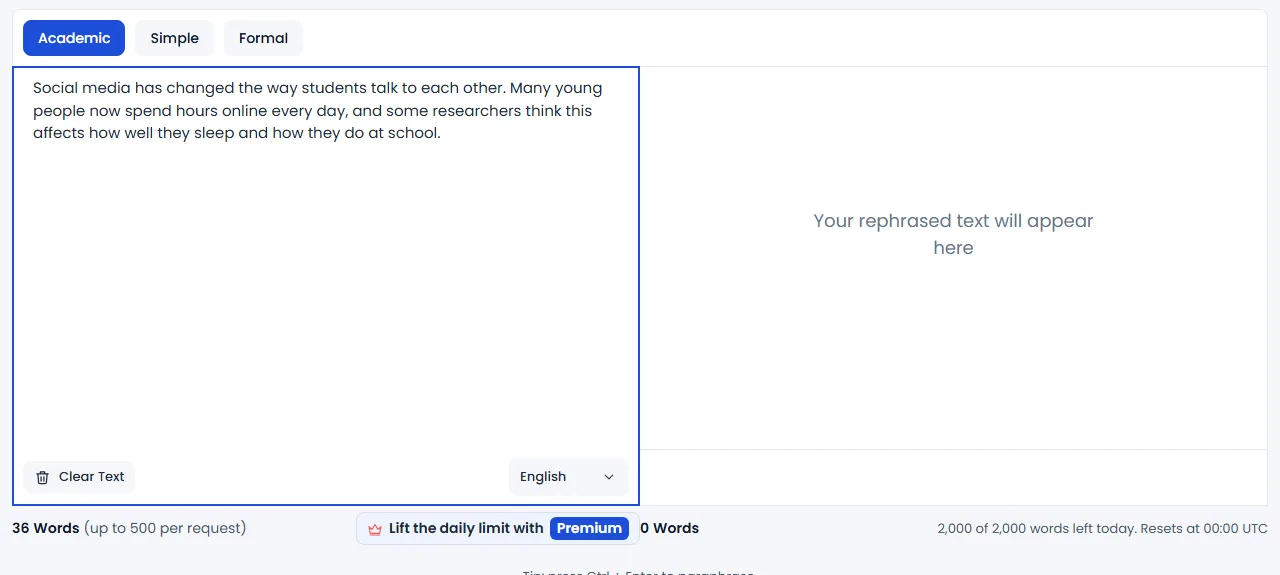
Where a tool helps is with your own rough draft. Once you have written the idea from memory, the academic mode in Rephrasa can suggest a clearer, more formal version. The Rephrasa paraphrasing tool shows before and after side by side and highlights changed words, so you can run the compare step from this guide. It is instructed to keep citations, numbers and technical terms, but check them yourself, because no rewriting model is perfect.
Three rules we recommend for any paraphrasing tool:
- Paste your own draft, not the source passage, whenever you can.
- Compare the output with the original source for accuracy and distance.
- Keep the citation. A tool-assisted paraphrase needs the same credit as one written by hand, and your school's rules on AI-assisted writing still apply.
Rephrasa does not store the text you paste after it is processed. And if you are unsure whether to paraphrase at all, use APA's filter: is the exact wording the point? If yes, quote it. If not, the six steps above are how to paraphrase it well.
Frequently asked questions
How do you paraphrase without plagiarizing?
Understand the passage, put it away, and write the idea from memory in your own sentence structure. Keep technical terms and numbers exact, compare your version with the original for accuracy and wording, and cite the source. Changing only a few words to synonyms is still plagiarism.
Do you need to cite a paraphrase?
Yes. A paraphrase restates someone else's idea, so the idea still belongs to the original author. APA says to cite the original work when you paraphrase, and the MLA counts paraphrasing someone's ideas without proper credit as plagiarism.
How do I paraphrase a quote?
Treat the quoted words like any other passage: restate the point in your own structure, remove the quotation marks and keep the citation. If one distinctive phrase is worth keeping, keep only that phrase in quotation marks. Keep the full quote instead when the exact wording is the point, such as a definition.
Do I need a page number when I paraphrase in APA?
No, APA 7 does not require a page or paragraph number for a paraphrase. You may add one, together with the author and year, when it helps readers find the passage in a long or complex work such as a book.
What is the difference between paraphrasing and summarizing?
A paraphrase restates a specific passage in full, in your own words. A summary is shorter and focuses on the main idea only. The Purdue OWL describes a paraphrase as a more detailed restatement than a summary. Both need a citation.
Can I use a paraphrasing tool for academic writing?
A tool can help you polish a paraphrase you have already drafted from your own understanding. Compare its output with the original for accuracy, check numbers and technical terms, keep the citation, and follow your school's rules on AI-assisted writing.
What should stay the same when you paraphrase?
Technical terms, numbers and hedges should stay exactly as they are. Terms such as carbon dioxide or statistical significance usually have no good synonym, and changing a number or a hedge like "about" or "may" changes the claim.
How do you rephrase a single sentence?
Combine two or three techniques: change the subject, switch between active and passive voice, change the word class, split or combine sentences, or reorder the ideas. Keep the facts, such as numbers and dates, exactly the same.
Sources
- Purdue OWL: Paraphrase: Write It in Your Own Words
- APA Style: Paraphrases
- APA Style: Quotations
- APA Style: Plagiarism
- MLA Style Center: Plagiarism and Academic Dishonesty
- MLA Style Center: Citing a paraphrase of several sentences
- UNC Writing Center: Plagiarism
- NOAA National Ocean Service: What is ocean acidification?