
Paraphrase Meaning: What Paraphrasing Is, With Examples
Show contents
- Paraphrase meaning and definition in plain words
- Why academic writers paraphrase
- Paraphrase vs quote vs summary
- Paraphrasing examples: a sentence and a short passage
- Paraphrase, rephrase and reword: close synonyms
- Does a paraphrase need a citation?
- How a paraphrasing tool helps, and where it stops
- A quick check before you keep a paraphrase
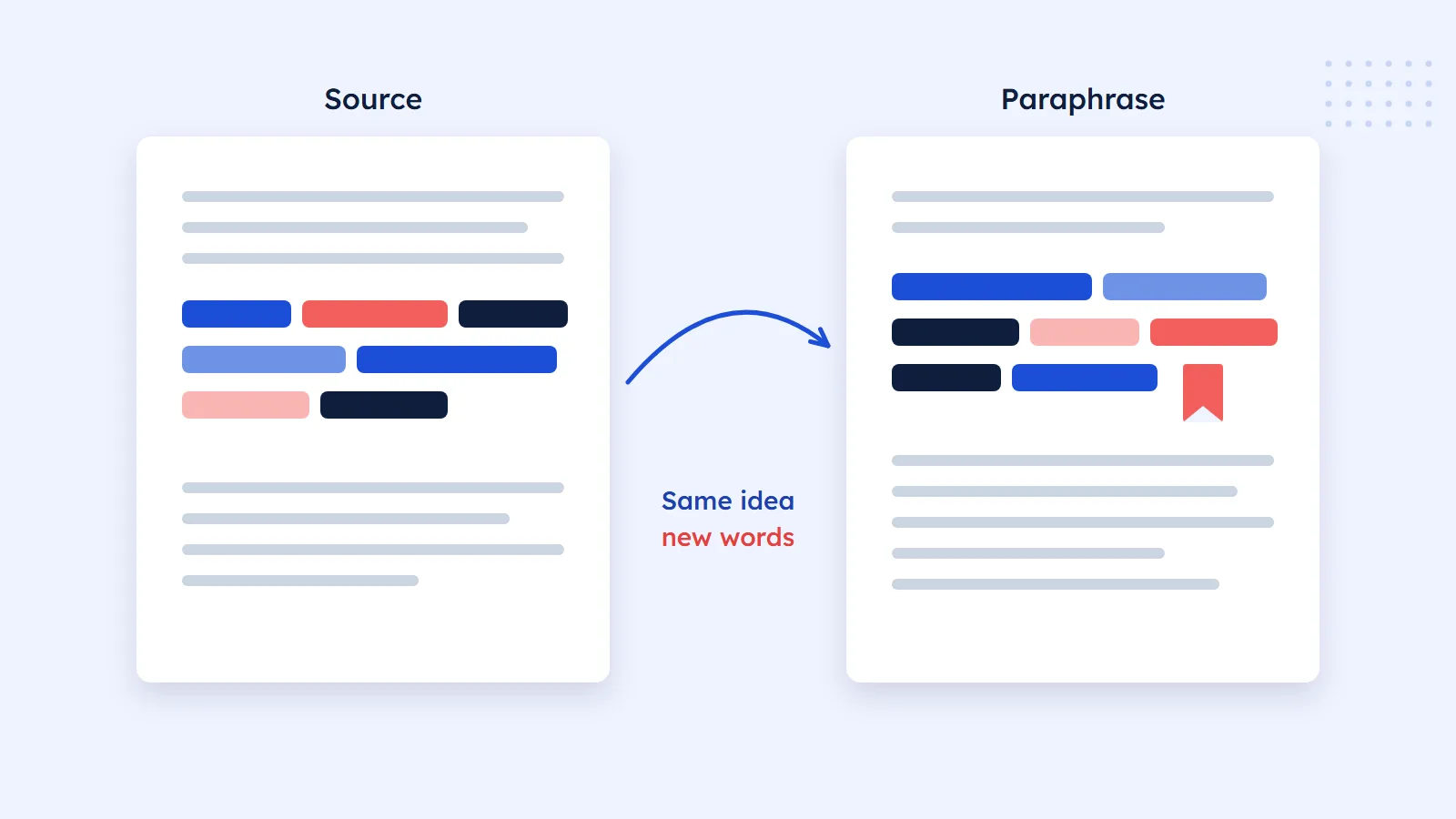
The paraphrase meaning is simple: to paraphrase is to restate someone else's idea in your own words and your own sentence structure, while keeping the original meaning and giving credit to the source. The APA Style guide defines a paraphrase as a restatement of "another's idea (or your own previously published idea) in your own words" (APA Style, Paraphrases).
So what paraphrasing means in practice is a change of wording, not a change of owner. The idea still belongs to the original author, which is why a paraphrase needs a citation just like a quote does. This guide gives you the definition in plain words, explains why academic writers paraphrase so often, compares paraphrasing with quoting and summarizing in one table, and walks through two short examples, including one that goes wrong.
Paraphrase meaning and definition in plain words
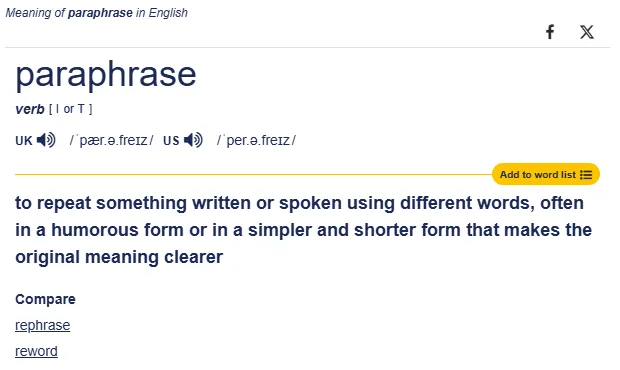
Dictionaries agree on the core. The Cambridge Dictionary defines the verb paraphrase as "to repeat something written or spoken using different words, often in a humorous form or in a simpler and shorter form that makes the original meaning clearer." As a noun, a paraphrase is that new version itself.
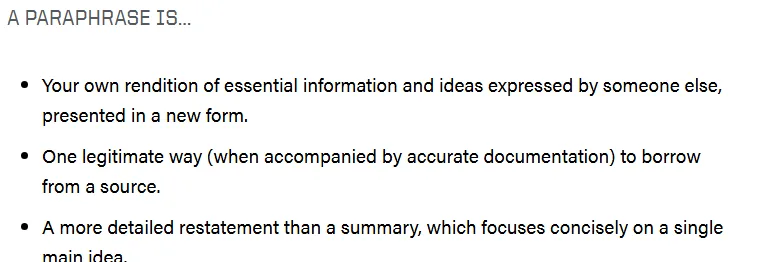
Academic writing adds two conditions that a dictionary does not stress. First, the meaning has to stay accurate. Second, the source has to be credited. The Purdue OWL describes a paraphrase as "your own rendition of essential information and ideas expressed by someone else, presented in a new form," and calls it a legitimate way to borrow from a source only "when accompanied by accurate documentation" (Purdue OWL, Paraphrasing).
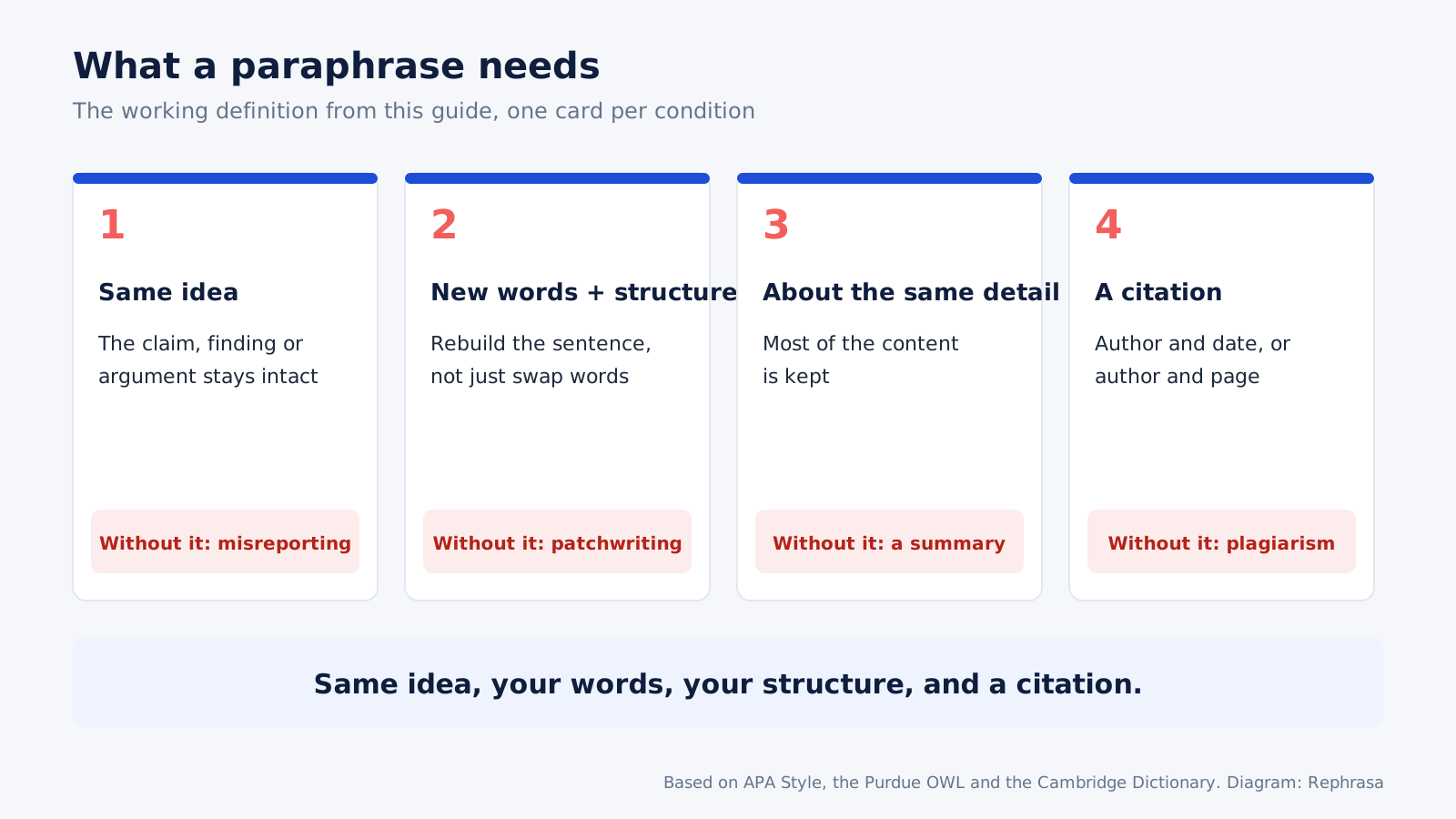
Put together, a working paraphrase definition for students looks like this:
- Same idea: the claim, finding or argument of the source stays intact.
- New words and new structure: you rebuild the sentence, not just swap a few words.
- About the same level of detail: a paraphrase keeps most of the content, which is what separates it from a summary.
- A citation: author and date (or author and page in MLA) point the reader to the original.
If you came here asking "what does it mean to paraphrase something?", that list is the short answer. The rest of this article shows why each part matters.
Why academic writers paraphrase
You might expect quoting to be the safer choice, since the words are exactly right. Style guides say the opposite. APA states that published authors "paraphrase their sources most of the time, rather than directly quoting the sources," and that student authors should do the same (APA Style). Its quotations page adds that paraphrasing "allows you to fit material to the context of your paper and writing style" (APA Style, Quotations).
There are three practical reasons behind that advice:
- It shows understanding. You cannot restate an idea well without grasping it. The Purdue OWL notes that the mental work of paraphrasing "helps you to grasp the full meaning of the original."
- It keeps your voice in charge. A paper stitched together from long quotes reads like a scrapbook. The UNC Writing Center reminds students that "the majority of your paper should still be your original ideas in your own words" (UNC Writing Center, Quotations).
- It lets you combine sources. APA points out that paraphrasing lets you "summarize and synthesize information from one or more sources" and "compare and contrast relevant details." A single sentence can then carry two or three citations.
Our view: the real value of paraphrasing is that it forces a decision. When you paraphrase, you have to decide what the source actually says and why it matters to your argument. That decision is the thinking your instructor wants to see, and a quote lets you skip it.
Paraphrase vs quote vs summary
The three ways of using a source differ in how close your text stays to the original. The Purdue OWL puts it this way: quotations "must match the source document word for word," paraphrasing puts "a passage from source material into your own words," and summarizing puts "the main idea(s) into your own words, including only the main point(s)" (Purdue OWL, Quoting, Paraphrasing, and Summarizing).
| Feature | Quote | Paraphrase | Summary |
|---|---|---|---|
| Wording | Exactly the author's words, in quotation marks | Your own words and sentence structure | Your own words |
| Length | A narrow segment, as long as the original | Close to the original, often slightly shorter | Much shorter than the original |
| Detail kept | All of it | Most of the ideas and details | Only the main point or points |
| Citation needed | Yes, with page or location number | Yes (page number optional in APA, usual in MLA) | Yes |
| Best used when | Exact wording matters | The idea matters more than the wording | You need the gist of a long text |
When should you quote instead? APA lists three cases: when you reproduce an exact definition, when an author has said something "memorably or succinctly," or when you want to respond to the exact wording (APA Style, Quotations). Everything else is usually a job for a paraphrase. If you are unsure, ask yourself whether the reader needs the author's words or only the author's point.
Paraphrasing examples: a sentence and a short passage
The two source texts below were written by us for practice. The author "Lee" and the study are fictional, so the citations show the format only.
Example 1: paraphrase in a sentence
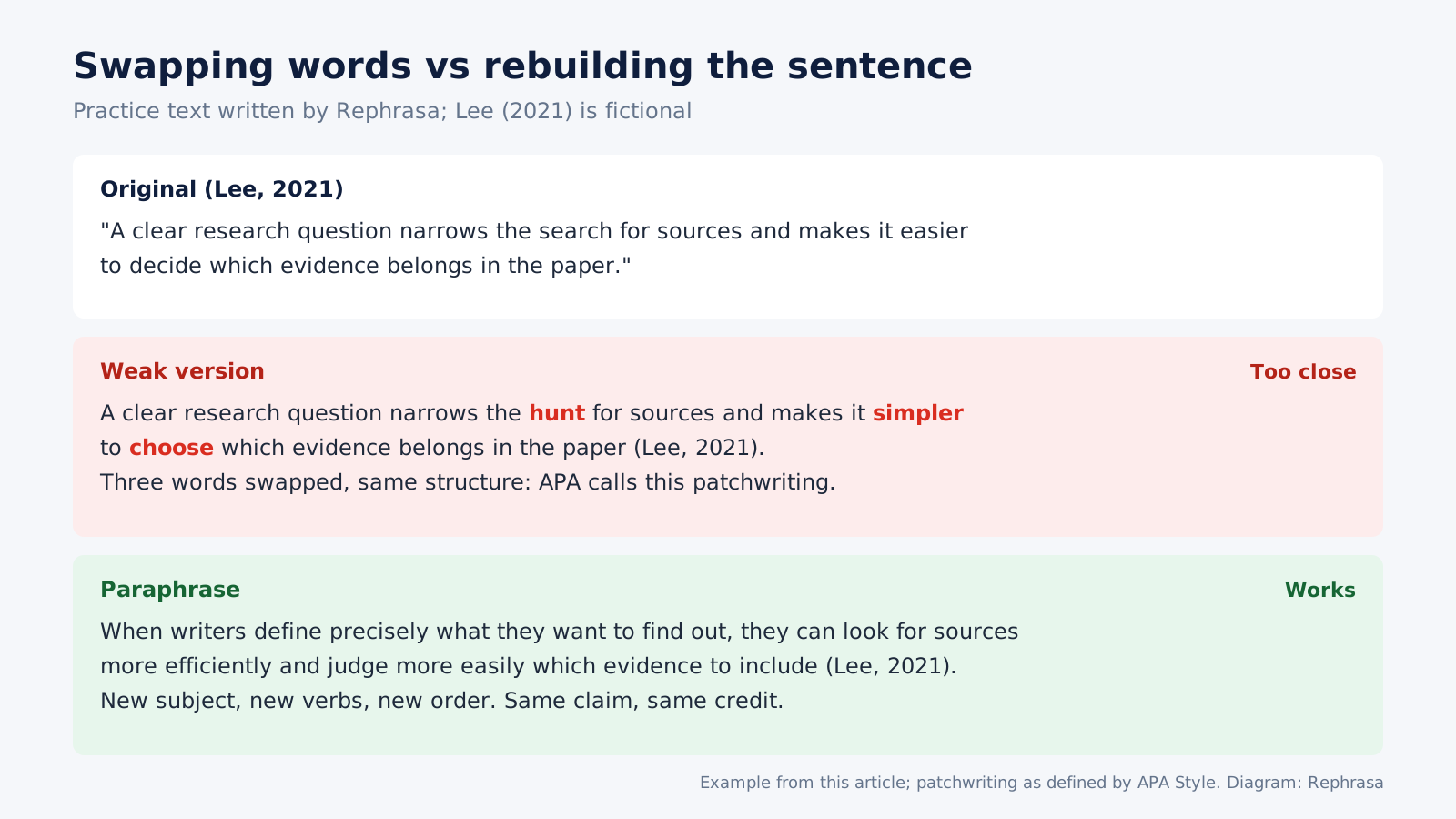
Original: "A clear research question narrows the search for sources and makes it easier to decide which evidence belongs in the paper." (Lee, 2021)
Paraphrase: When writers define precisely what they want to find out, they can look for sources more efficiently and judge more easily which evidence to include (Lee, 2021).
Notice what changed. The subject moved from "a clear research question" to "writers," the verbs are new, and the sentence order is different. What did not change is the claim and the credit.
Example 2: paraphrasing a short passage with numbers
Original: "In the pilot survey, 42 of the 60 participants said they revised their drafts at least twice before submission. The authors caution that the sample came from a single university and may not represent other student groups." (Lee, 2021, p. 14)
Paraphrase: Lee (2021) reported that 42 of 60 pilot respondents went through two or more rounds of revision before handing in their work, although the study drew on one university only, so the result may not hold for students elsewhere (p. 14).
Two rules show up here. The numbers stay exactly as they are, because changing data is not paraphrasing, it is misreporting. And the caution in the second sentence stays too. Dropping an author's limitation is one of the quietest ways a paraphrase can distort a source.
A paraphrase that does not work
Weak version: A clear research question narrows the hunt for sources and makes it simpler to choose which evidence belongs in the paper (Lee, 2021).
This keeps the original sentence and swaps three words. APA calls this kind of text, where "a few words have been changed but content is largely the same," patchwriting (APA Style, Plagiarism). Even with a citation, many instructors will treat it as too close to the source. The fix is to change the structure, not only the vocabulary.
Paraphrase, rephrase and reword: close synonyms
People often search for a paraphrase synonym, and the closest ones are rephrase and reword. They overlap, but they are not identical:
- Rephrase: "to say or write something again in a different and usually clearer way" (Cambridge Dictionary). The rephrase meaning focuses on clarity, often for your own sentence.
- Reword: "to write something again in different words" (Cambridge Dictionary). The reword definition is about the words themselves, which is why rewording alone can stay too close to a source.
- Paraphrase: restating another person's idea in your own words. In academic use, it also implies accuracy and a citation.
Other related words include restate, rewrite and put in your own words. In everyday talk they can be used almost interchangeably. In a paper, though, paraphrase is the precise term, because it signals that the idea came from a source. Rephrasing your own clumsy sentence needs no citation. Paraphrasing someone else's finding always does.
Does a paraphrase need a citation?
Yes, every time. This is the part of the paraphrase definition that students most often miss. The MLA Style Center lists "paraphrasing someone's ideas or arguments or copying someone's unique wording without giving proper credit" as a form of plagiarism (MLA Style Center). APA defines plagiarism as "presenting the words, ideas, or images of another as your own" and asks writers to cite both direct quotations and ideas (APA Style, Plagiarism).
How the citation looks depends on the style:
- APA 7: author and year, either narrative, Lee (2021), or parenthetical, (Lee, 2021). A page number is not required for a paraphrase, but APA says you may add one for a long or complex work.
- MLA 9: author and page, such as (Lee 14). Our guide to MLA in-text citations covers the details.
- Long paraphrases: APA lets you cite once at the start when several sentences paraphrase the same work and the context stays clear, then cite again if the paraphrase continues into a new paragraph.
For a side-by-side view of APA, MLA, Chicago, Harvard, IEEE and AMA, read our overview of in-text citations, or go straight to the APA in-text citation rules. Then add the full entry to your reference list. Our free citation generator builds it from a DOI, URL or ISBN in your browser, and you can edit every field before you copy it.
How a paraphrasing tool helps, and where it stops
A paraphrasing tool rewrites text you paste into it. Used well, it is a drafting aid. It can show you a second way to build a sentence when you are stuck, simplify a dense passage so you understand it, or lift the register of your own draft into academic English.
The Rephrasa paraphrasing tool works this way. You pick a mode, and the before and after panels show which words changed. The academic paraphrasing tool mode keeps a scholarly register, the simple mode makes text plainer, and the formal mode suits reports and applications. It is told to keep citations, numbers and technical terms as they are, and it does not store your text after processing.
Now the honest part. No tool can do the three things that make a paraphrase legitimate:
- Understand your argument. A tool does not know why you are using the source, so it cannot decide what to keep or cut.
- Guarantee the meaning. Rewording can soften a claim, drop a limitation or change "may" into "does." Only a check against the original catches that.
- Give credit. A paraphrase from a tool is still the source author's idea. It needs the same citation as a paraphrase you wrote by hand.
We would go further than most tool makers: if you have not read the source, do not paraphrase it with any tool. Read it, write your own rough version first, and use the tool to polish your sentence rather than to replace your reading. Our guide on how to paraphrase walks through that method step by step.
A quick check before you keep a paraphrase
Before a paraphrase goes into your final draft, run through these five questions. They take less than a minute per passage.
- Could a reader who knows the source recognize the same idea, with nothing added and nothing important removed?
- Did you change the sentence structure, not just a few words?
- Are all numbers, names and technical terms exactly as in the source?
- Did you put quotation marks around any distinctive phrase you kept word for word? The Purdue OWL recommends this for "any unique term or phraseology" borrowed exactly.
- Is there an in-text citation, and a matching entry in your reference list?
If every answer is yes, you have a sound paraphrase. To sum up the paraphrase meaning once more: same idea, your words, your structure, and a citation. Get those four right and paraphrasing becomes the strongest way to bring sources into your own writing.
Frequently asked questions
What is the meaning of paraphrase?
To paraphrase means to restate someone else's idea in your own words and sentence structure while keeping the original meaning. In academic writing, a paraphrase must also cite the original source.
What is the difference between paraphrasing and summarizing?
A paraphrase keeps most of the ideas and details of a passage and is about as long as the original. A summary keeps only the main point or points and is much shorter. Both are in your own words and both need a citation.
Do I need to cite a paraphrase?
Yes. Paraphrasing changes the wording, not the owner of the idea. MLA and APA both treat paraphrasing someone's ideas without credit as plagiarism, so every paraphrase needs an in-text citation and a reference list entry.
Is changing a few words in a sentence a paraphrase?
No. Swapping a few words while keeping the original structure is what APA calls patchwriting. A real paraphrase rebuilds the sentence in your own words and structure.
Is it acceptable to use a paraphrasing tool for academic work?
A tool can help you draft or polish a sentence, but you still need to read the source, check that the meaning is accurate, and cite it. Follow your instructor's or institution's policy on AI-assisted writing.
What are other words for paraphrase?
The closest synonyms are rephrase and reword, and related words include restate, rewrite and put in your own words. In a paper, paraphrase is the precise term because it signals that the idea came from a source and needs a citation.
When should I quote instead of paraphrasing?
APA lists three cases for quoting: reproducing an exact definition, when an author has said something memorably or succinctly, and when you want to respond to the exact wording. In most other cases a paraphrase is the better choice.
Can I change numbers when I paraphrase?
No. Numbers, names and technical terms stay exactly as they are in the source. Changing data is misreporting, not paraphrasing, and you should also keep any limitation or caution the author gives.
Sources
- APA Style, "Paraphrases" (American Psychological Association, last updated July 2022)
- APA Style, "Quotations" (American Psychological Association)
- APA Style, "Plagiarism" (American Psychological Association)
- MLA Style Center, "Plagiarism and Academic Dishonesty"
- Purdue OWL, "Paraphrase: Write It in Your Own Words"
- Purdue OWL, "Quoting, Paraphrasing, and Summarizing"
- UNC Writing Center, "Quotations"
- Cambridge Dictionary, "paraphrase"
- Cambridge Dictionary, "rephrase"
- Cambridge Dictionary, "reword"