
Harvard Referencing: A Complete Guide With Examples
Show contents
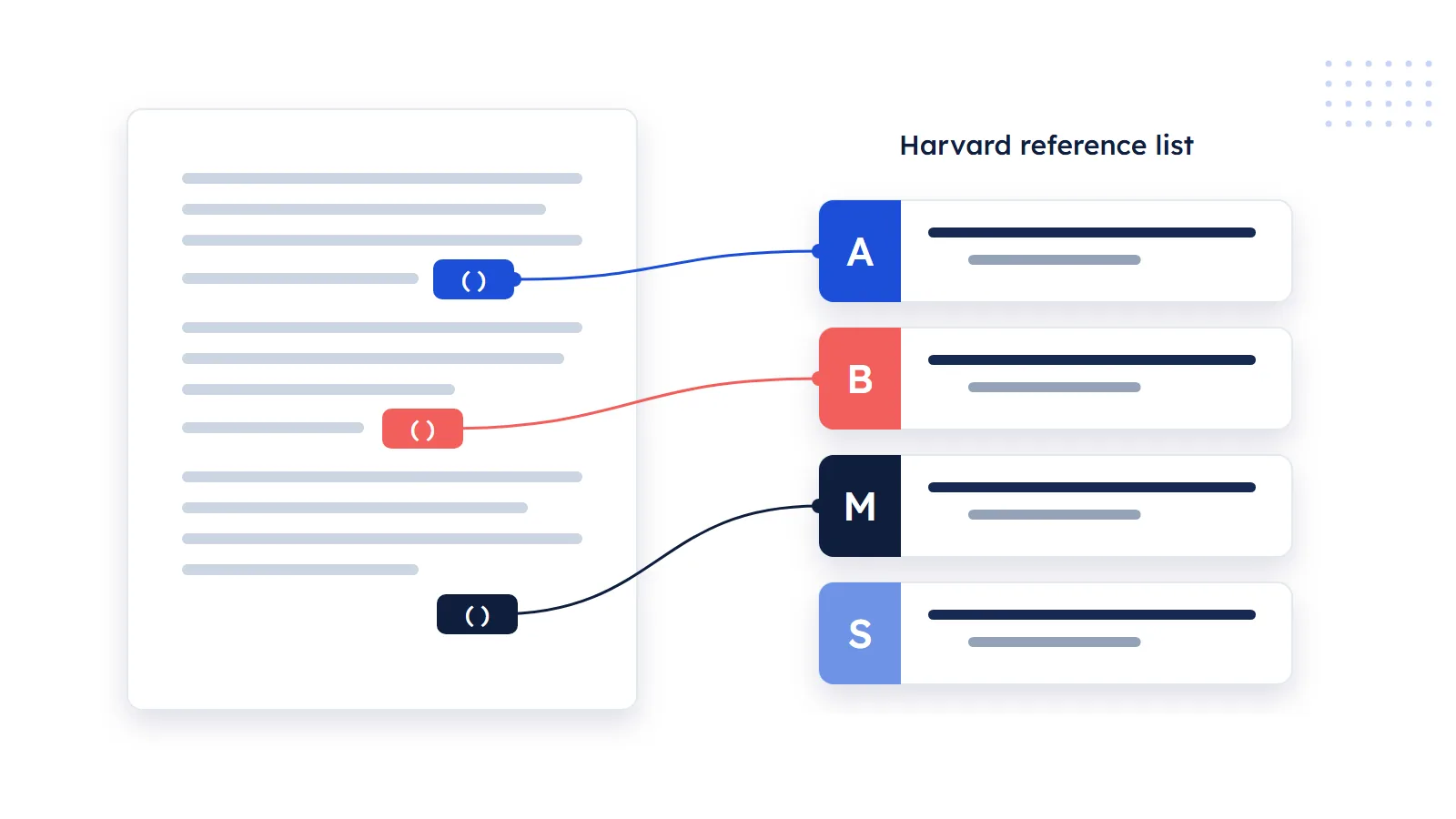
Harvard referencing is an author-date citation system. In your text you give the author's surname and the year in round brackets, for example (Gulddal, 2020), and at the end you list the full details of every source in a reference list ordered alphabetically by surname. That is the whole idea; the rest is punctuation.
The punctuation is where students lose marks, because there is no single official Harvard manual. This guide follows Cite Them Right, the version that the Reading, Newcastle and UCL library guides are based on, and every example below is copied from a university library guide that publishes it. Where versions disagree, we say so.
What is Harvard referencing?
Harvard is a family of author-date styles rather than one fixed rulebook, and many university libraries publish their own Harvard guide. Each source you use appears twice: once as a short citation inside your sentence, and once as a full entry in the reference list.
The UCL Library guide sums up the in-text part in three items: the author or editor surname, the year of publication, and the page number if needed (UCL Library Services). The reference list then answers a few questions about each source: who made it, what it is called, what larger work it belongs to, who published it and when.
Two parts that must match is the point of Harvard referencing. A reader who sees (Ashbourn, 2014) in your essay should find exactly one entry starting with "Ashbourn, J. (2014)" in your list. If the two halves drift apart, for example a different year or a misspelt surname, the citation stops doing its job, however neat the formatting looks.
Why there is more than one Harvard style
Harvard referencing is a convention, not a trademark, so universities have written their own versions over the years. UCL states it plainly: "there are many variations of the Harvard style", and students should match the version recommended in their course handbook (UCL Library Services). The University of Reading adds that Harvard "is a style rather than a set of rules, so details of punctuation and text formatting may differ" (University of Reading Library).
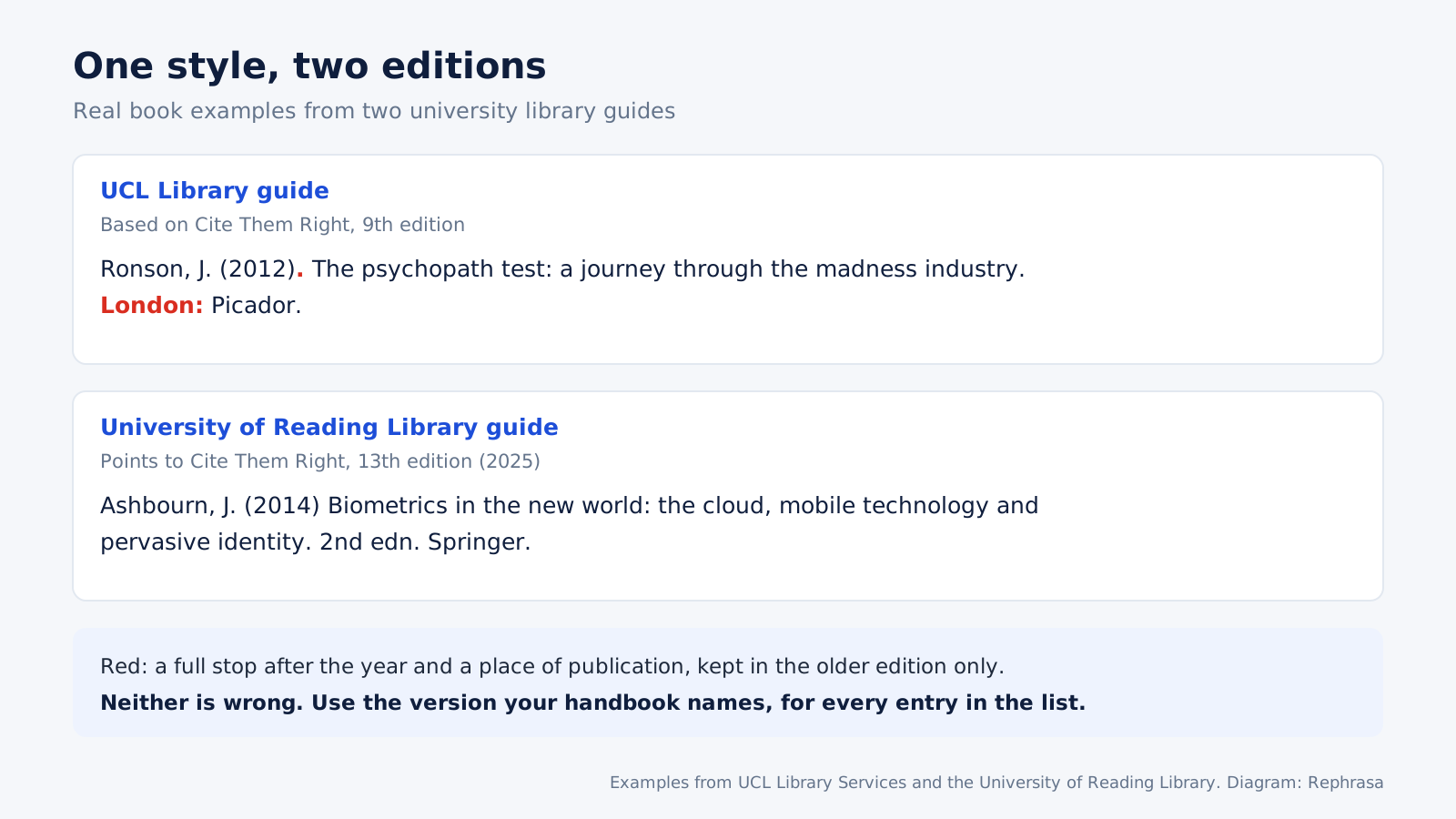
Compare two real book examples. UCL's guide, based on the 9th edition of Cite Them Right, prints a full stop after the year and keeps the place of publication:
Ronson, J. (2012). The psychopath test: a journey through the madness industry. London: Picador.
Reading, which points students to the 13th edition (2025), drops both:
Ashbourn, J. (2014) Biometrics in the new world: the cloud, mobile technology and pervasive identity. 2nd edn. Springer.
Neither is wrong. They are different editions of the same guide. In our view the fix is simple: find the name of the version in your module handbook, then use it consistently. A tutor will usually forgive a version choice; mixing two versions in one list looks careless.
Which version does Rephrasa use? The Harvard option in our generator is built on the open Cite Them Right 12th edition CSL style, and we label it that way. Cite Them Right Online is the publisher's own reference site if your university gives you access.
Harvard in-text citations
In Harvard referencing, an in-text citation can sit in brackets at the end of a clause (parenthetical) or use the author's name as part of your sentence (narrative). Newcastle University's 2025 Cite Them Right style sheet shows both forms (Newcastle University Library):
- Parenthetical: Recent research (Jones and Henry, 2011, p. 1150) shows...
- Narrative: Evans (2015, p. 33) explains that...
Notice the comma between surname and year, which APA also uses, and the word "and" between two authors where APA uses "&" inside brackets.
Page numbers
UCL is firm here: "A direct quotation, or allusion, should always include the page number(s)" (UCL Library Services). For sources without pages, use whatever locator you have. Reading's e-book example cites a Kindle percentage, (Prior, 2020, 74%), and its YouTube example uses a time code, (TEDx Talks, 2018, 2:34) (University of Reading Library).
One, two, three or more authors
| Authors | Harvard (Cite Them Right) in-text |
|---|---|
| One | (Gulddal, 2020) |
| Two | (Thomas and Tian, 2021) |
| Three | (Adeyeye, Ashaolu and Idowu-Adebayo, 2022) |
| Four or more | (Moise et al., 2020) |
| Organisation as author | (World Health Organization, 2025) |
| No date | (Action on Salt, no date) |
All six examples come from the Reading guide (University of Reading Library).
Same author and year, and secondary sources
Two works by the same author in the same year get a lower-case letter after the year, such as (Smith, 2001b, p.20), with the letters assigned by alphabetising the titles in the reference list (Newcastle University Library).
If you only read a source quoted inside another book, say so with "quoted in" or "cited in": Smith (2018, quoted in Jones, 2020, p. 21). Only the source you actually read goes in your reference list. Both guides recommend tracking down the original first, and we agree: secondary citations are a common place for a quotation to be taken out of context.
How to format a Harvard reference list
The reference list sits at the end of your work, arranged alphabetically by the surname of the first author (Newcastle University Library). A reference list holds what you cited; a bibliography in the Cite Them Right sense also includes what you read but did not cite. Check which one your assignment asks for.
The templates and examples below are from the Reading and Newcastle guides, which follow Cite Them Right.
Book
Template: Surname, Initial. (Year) Title. Edition (if not the first). Publisher.
Ashbourn, J. (2014) Biometrics in the new world: the cloud, mobile technology and pervasive identity. 2nd edn. Springer.
Have the ISBN? The ISBN citation generator fills in the title, publisher and year for you.
Journal article
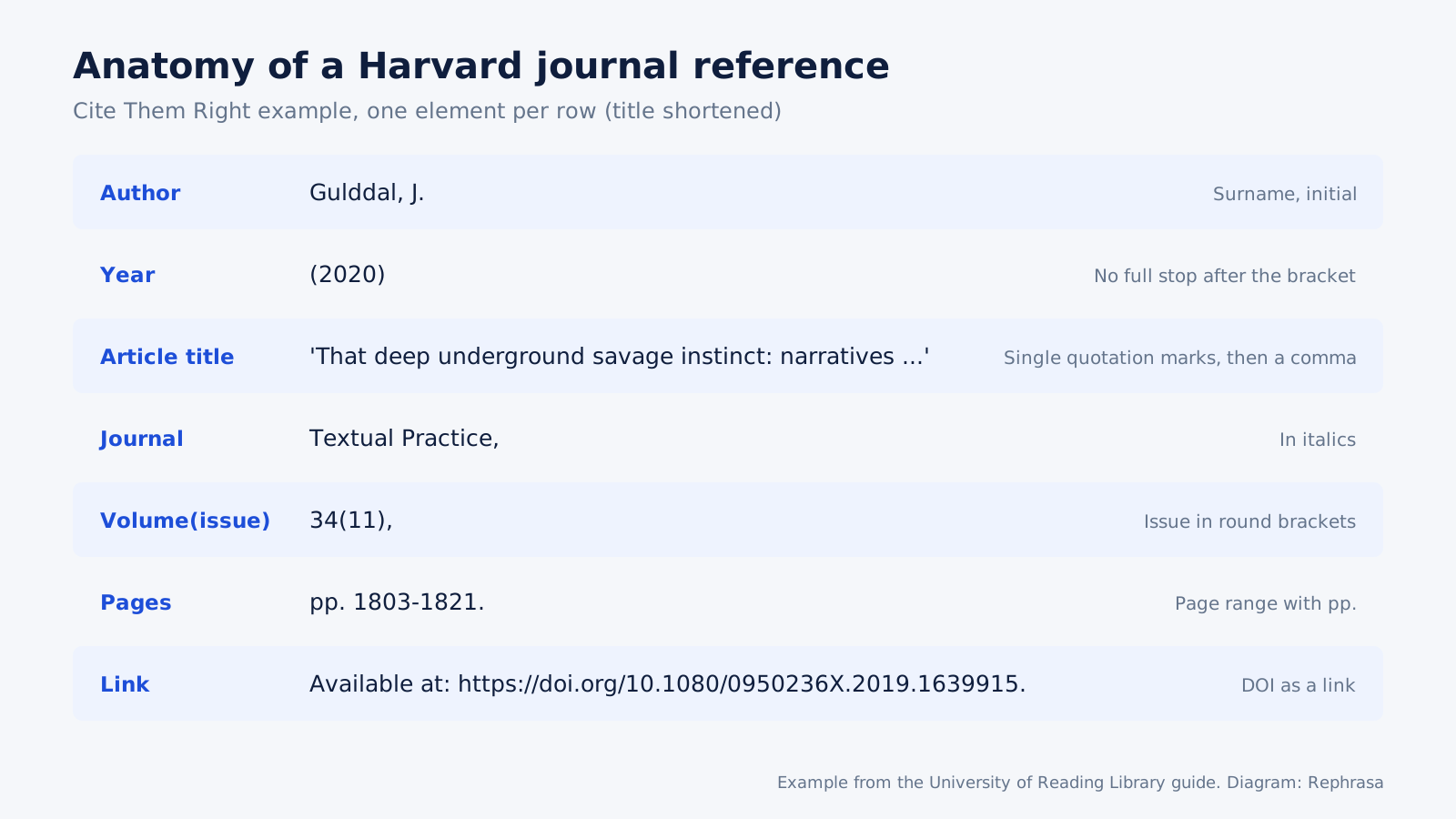
Template: Surname, Initial. (Year) 'Title of article', Title of Journal, volume(issue), page range. Available at: DOI.
Gulddal, J. (2020) 'That deep underground savage instinct: narratives of sacrifice and retribution in Agatha Christie's Appointment with Death', Textual Practice, 34(11), pp. 1803-1821. Available at: https:/
/ doi. org/ 10. 1080/ 0950236X. 2019. 1639915.
Reading's advice is useful: if you only have a bare DOI, turn it into a link by adding https://doi.org/ in front (University of Reading Library). Paste the DOI into our DOI to citation tool and it does this for you.
Chapter in an edited book
Isenhour, C. (2015) 'Sustainable consumption and its discontents', in H. Kopnina and E. Shoreman-Ouimet (eds.) Sustainability: key issues. Routledge, pp. 133-154.
Note that the editors' initials come before their surnames, the reverse of the author.
Website
Template: Author (Year published or last updated) Title of web page. Available at: URL (Accessed: date).
World Health Organization (2025) Sodium reduction. Available at: https:/
/ www. who. int/ news- room/ fact- sheets/ detail/ sodium- reduction (Accessed: 24 June 2025).
The accessed date is the day you viewed the page. If the page shows no date, write (no date) where the year would be. More website cases are on our guide to citing a website.
YouTube video
Template: Person or organisation posting the video (Year posted) Title. Date uploaded. Available at: URL (Accessed: date).
TEDx Talks (2018) The power of an entrepreneurial mindset: Bill Roche. 20 March. Available at: https:/
/ www. youtube. com/ watch? v= Ihs4VFZWwn4 (Accessed: 5 July 2025).
The "author" is the channel that posted the video, not necessarily the speaker (University of Reading Library).
Et al. rules in Harvard referencing
Et al. means "and others". In the text of an essay using Harvard referencing, Cite Them Right is consistent: name up to three authors, and use the first author plus et al. for four or more, as in Harrison et al. (2003) (Newcastle University Library).
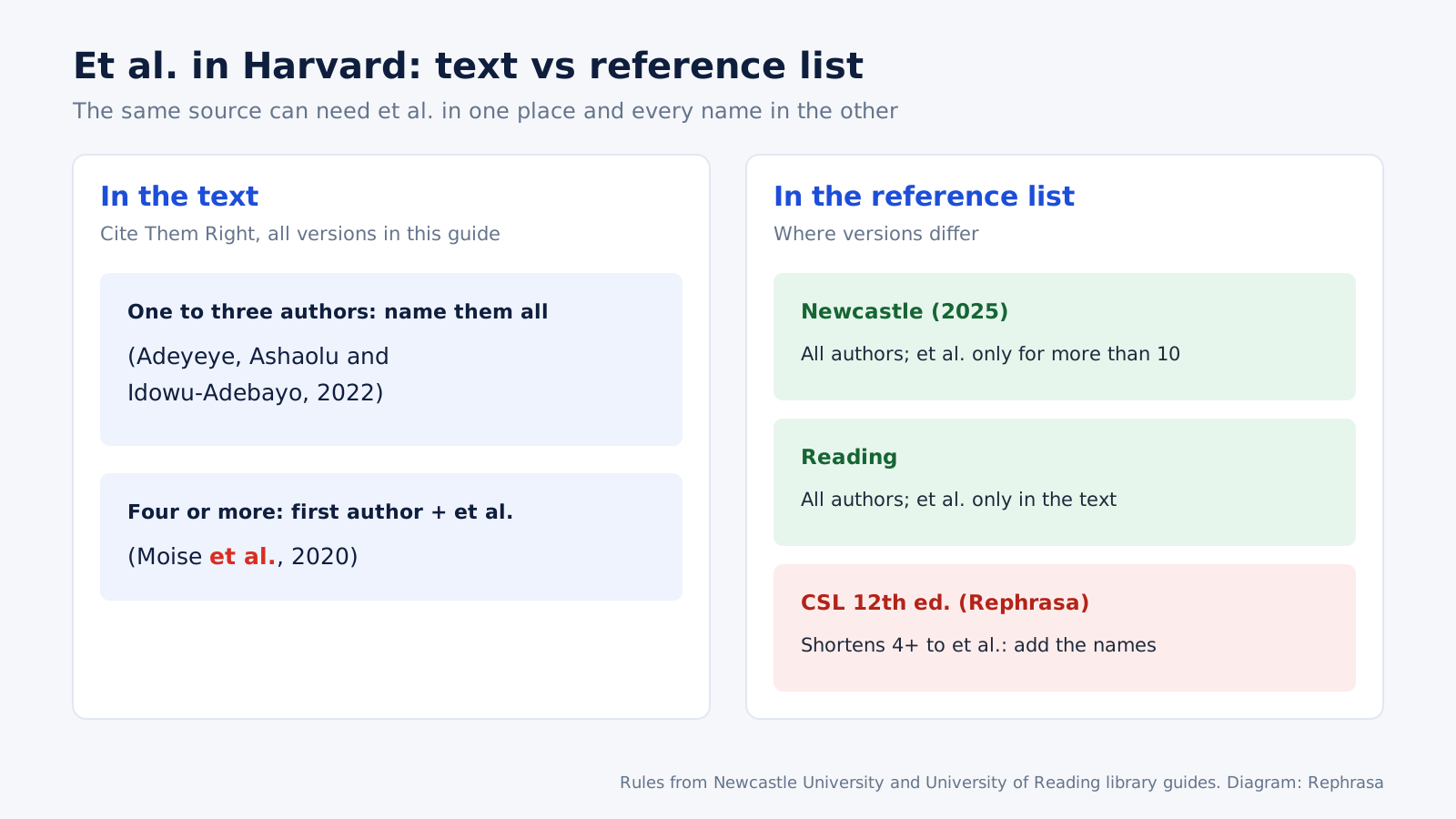
The reference list is where versions differ, and this is the rule students most often get wrong:
- Newcastle's 2025 style sheet: "you need to record all authors in your final reference list or bibliography. You can only use et al. if there are more than 10 authors" (Newcastle University Library).
- Reading: include all authors in the full reference, and use et al. only in the in-text citation (University of Reading Library).
Be aware of one limitation in our own tool. The Cite Them Right 12th edition CSL style that powers Rephrasa's Harvard option shortens four or more authors to "first author et al." in the reference list too. If your university follows the newer guidance above, add the remaining names after you paste the reference. We would rather tell you than let a generator quietly cost you marks.
Harvard vs APA: the differences that matter
Harvard referencing and APA 7 are both author-date systems, so they look alike at a glance. The details differ in ways a marker will notice. The APA column below is taken from the official APA Style pages (APA Style: author-date citation system; APA Style: elements of reference list entries).
| Point | Harvard (Cite Them Right) | APA 7 |
|---|---|---|
| Two authors in brackets | (Thomas and Tian, 2021) | (Salas & D'Agostino, 2020) |
| Et al. in the text | Four or more authors | Three or more authors, even in the first citation |
| Authors in the reference list | All authors (Newcastle and Reading guides) | Up to and including 20 authors |
| Year in the reference | (2020) with no full stop after it | (2019). with a full stop |
| Article title | In single quotation marks | No quotation marks, no italics, sentence case |
| Online sources | "Available at:" plus URL and (Accessed: date) | DOI or URL; a retrieval date only for unarchived pages designed to change |
If you were taught APA at school and now face Harvard at university, the accessed date and the single quotation marks are the two habits to change first. For the APA side in full, read our APA format guide, and for a side-by-side look at in-text styles see how in-text citations work across styles.
Common Harvard referencing mistakes
From the examples above, these are the Harvard referencing slips that are easiest to make and easiest to fix:
- Mixing versions. A full stop after the year in some entries and not in others. Pick one version and apply it to the whole list.
- Missing page numbers for quotations. Every direct quote needs a page, percentage or time code.
- Citing what you did not read. If you saw a source only inside another book, use "cited in" and list the book you read.
- Forgetting the accessed date for websites and videos.
- Using et al. too early. Three authors are all named in Cite Them Right; et al. starts at four.
- Treating paraphrased text as your own. Rewording a source in your own words still needs a citation. Our guide on how to paraphrase properly covers this.
Using a Harvard referencing generator well
A generator saves time on the fiddly part of Harvard referencing: capitalisation, italics and the order of elements. The Rephrasa Harvard referencing generator takes a DOI, URL or ISBN, looks up the details in your browser, and lets you correct each field before the reference is added. You can then copy the list or export it.
A generator is only as good as the metadata it finds, though. Websites often publish no author or a wrong date, and book records can list the wrong edition. Before you paste, check the author names, the year, the edition and the accessed date against the source itself. Two minutes of checking beats losing marks for a reference that looks perfect but points to the wrong thing.
Need another style for a different module? The same tool covers APA, MLA, Chicago, IEEE and AMA on the main citation generator, and there is a dedicated APA citation generator too.
Frequently asked questions
What is the difference between a reference list and a bibliography in Harvard?
A reference list contains every source you cited in your text. A bibliography, in the Cite Them Right sense, also includes sources you read but did not cite. Both are ordered alphabetically by the first author's surname. Use whichever your assignment brief asks for.
Is Cite Them Right the same as Harvard?
Cite Them Right is one published version of Harvard, and it is the version the University of Reading, Newcastle University and UCL library guides are based on. Other universities use their own Harvard versions with small differences in punctuation, so check your course handbook for the exact version.
Do I need page numbers in Harvard in-text citations?
Yes, whenever you quote directly or point to a specific passage, for example (Jones and Henry, 2011, p. 1150). For sources without pages, use another locator such as a percentage for an e-book or a time code for a video.
How do I reference a source with no date in Harvard?
Write "no date" in brackets where the year would go, for example (Action on Salt, no date) in the text and Action on Salt (no date) at the start of the reference list entry.
When do I use et al. in Harvard referencing?
In the text, Cite Them Right uses et al. for four or more authors. In the reference list, current university guides such as Newcastle and Reading ask you to list all authors; Newcastle allows et al. only for more than 10 authors.
Is a Harvard referencing generator accurate?
The formatting is consistent, but the result depends on the details the tool finds. Always check the author names, year, edition and accessed date against the source before you paste the reference into your work.
How do you reference a website in Harvard?
Give the author or organisation, the year published or last updated in brackets, the title of the page, then Available at: with the URL and the date you viewed it, for example World Health Organization (2025) Sodium reduction. Available at: URL (Accessed: 24 June 2025). If the page has no date, write (no date).
How do I cite two works by the same author from the same year in Harvard?
Add a lower-case letter after the year, such as (Smith, 2001b, p.20). The letters are assigned by putting the titles in alphabetical order in the reference list, and the same letter appears in the reference entry.
Sources
- University of Reading Library: Reference examples (Harvard style)
- Newcastle University Library: Cite Them Right Harvard style sheet (2025)
- UCL Library Services: Referencing with Harvard
- APA Style: Author-date citation system
- APA Style: Elements of reference list entries
- Cite Them Right Online
- Citation Style Language: Cite Them Right 12th edition (harvard-cite-them-right.csl)