
Annotated Bibliography: How to Write One (APA and MLA Examples)
Show contents
- What an annotated bibliography is
- What goes in an annotation: summary, evaluation, reflection
- Annotated bibliography length and format
- APA annotated bibliography example (7th edition)
- MLA annotated bibliography example (9th edition)
- How to write an annotated bibliography, from search to final list
- Let a generator build the citation, then write the annotation yourself
- Common annotated bibliography mistakes
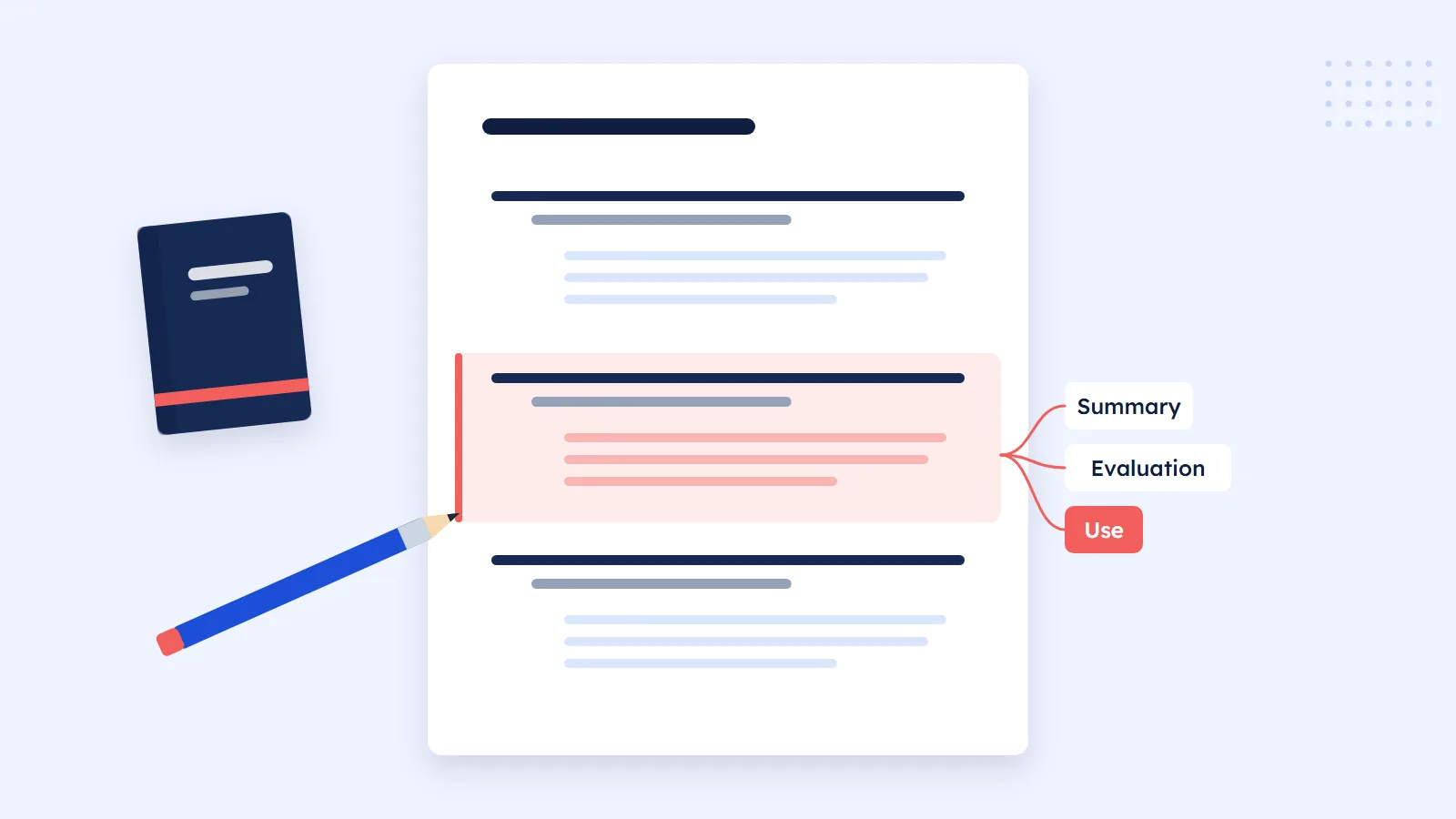
An annotated bibliography is a list of sources in which every citation is followed by a short paragraph, the annotation, that summarizes the source, judges how useful and reliable it is, and often explains how it fits your project. The citation follows your style guide (APA, MLA, Chicago or another), and the annotation is your own writing about the source.
This guide covers what an annotation contains, how long it should be, how APA 7 and MLA 9 format the page, and two complete examples built from the same real source so you can see exactly where the styles differ. Every rule is linked to the APA or MLA style website or a university library guide that quotes the manuals.
What an annotated bibliography is
APA draws a clear line between two lists that students often mix up. A reference list holds the works that support the claims in your paper, while a bibliography "provides works for background or further reading and may include descriptive notes (e.g., an annotated bibliography)," according to the APA Style page on reference lists versus bibliographies. It is a reading record that shows what each source says and why you kept it.
Instructors assign them for a practical reason. The Purdue OWL guide to annotated bibliographies points out that writing an annotation forces you to read each source more carefully, so you "read more critically instead of just collecting information." In our view, this is the part students underrate. Ten honest annotations prove you understood what you found, and they become the skeleton of your literature review.
Annotation versus abstract
An annotation is not the abstract printed at the top of a journal article. The Cornell University Library guide explains that abstracts are purely descriptive, while annotations are "descriptive and critical" and may comment on the author's point of view, authority, or clarity. Rewording the abstract skips the evaluation your instructor is grading.
What goes in an annotation: summary, evaluation, reflection
Most annotations combine up to three moves. The Purdue OWL names them summarize, assess and reflect, and your assignment may ask for one, two, or all three. Here is what each one answers:
- Summary: What is the source about? What is its main argument, method, or finding, and what topics does it cover?
- Evaluation: Is it reliable and current? Who wrote it, for which audience, and how does it compare with your other sources?
- Reflection: How will you use it? Does it support your thesis, challenge it, or fill a gap in your evidence?
Cornell's guide gives a similar checklist. After summarizing the central theme and scope, add sentences that evaluate the author's authority or background, comment on the intended audience, compare the work with another source you cite, or explain how it illuminates your topic.
The weight of each move depends on the type of annotation your instructor wants:
| Type | Main job | Typical content |
|---|---|---|
| Descriptive (informative) | Summarize | Topic, scope, main argument or findings, method |
| Evaluative (critical) | Summarize and judge | Summary plus strengths, limits, bias, authority, comparison with other sources |
| Reflective | Connect to your project | Short summary plus how the source shapes your argument or research question |
If the brief only says "annotated bibliography" with no type, we would write the evaluative kind with one reflective sentence at the end. It shows the most thinking for the same word count. It also matches the purpose Cornell gives an annotation: telling the reader about the relevance, accuracy and quality of each source.
Annotated bibliography length and format
There is no single required length. Cornell describes an annotation as a brief paragraph of "usually about 150 words," and the Purdue OWL notes lengths can range from a couple of sentences to a couple of pages depending on the purpose. The MLA Style Center adds that annotations "should generally be no more than one paragraph" (MLA Style Center on annotation paragraphs). Your instructor's word limit always wins over these defaults.
Formatting is where APA and MLA differ. The citation is formatted as in a normal reference list or works cited list; what changes is the annotation indent and the page label.
| Rule | APA 7 | MLA 9 |
|---|---|---|
| Citation format | Same as a reference list entry | Same as a works cited entry |
| Order | Alphabetical by the first word of the entry, usually the first author's last name | Alphabetical by author or title, or by date or subject |
| Citation indent | 0.5 in. hanging indent | 0.5 in. hanging indent |
| Annotation indent | Whole annotation 0.5 in. from the left margin, first line not indented further | 1 in. from the start of the entry |
| Spacing | Double-spaced, no extra blank lines between entries | Double-spaced, no extra space between paragraphs |
| Page label | APA's student template repeats the paper title at the top of the list | Annotated Bibliography or Annotated List of Works Cited |
Sources for the table: the APA reference list setup page (order, hanging indent, double spacing), the Felician University APA 7 guide (annotation indent, including an extra 0.5 in. for the first line of any second paragraph), APA's own annotated bibliography student template on its sample papers page, the MLA Style Center guidance for annotated bibliographies (title and order), and the Middlebury College guide, which quotes MLA Handbook section 5.132 on the one-inch annotation indent.
Watch out: many older MLA samples online still show eighth-edition layouts. The ninth edition uses the one-inch annotation indent so the note stands apart from the hanging indent. The Purdue OWL samples page confirms this and lists a 0.5-inch indent for Chicago, as in APA.
APA annotated bibliography example (7th edition)
To keep the examples honest, both are built from one real, openly readable source: a Pew Research Center short read by Katherine Schaeffer about the "homework gap" during the pandemic. The citation below is copied exactly from the APA webpage reference examples.
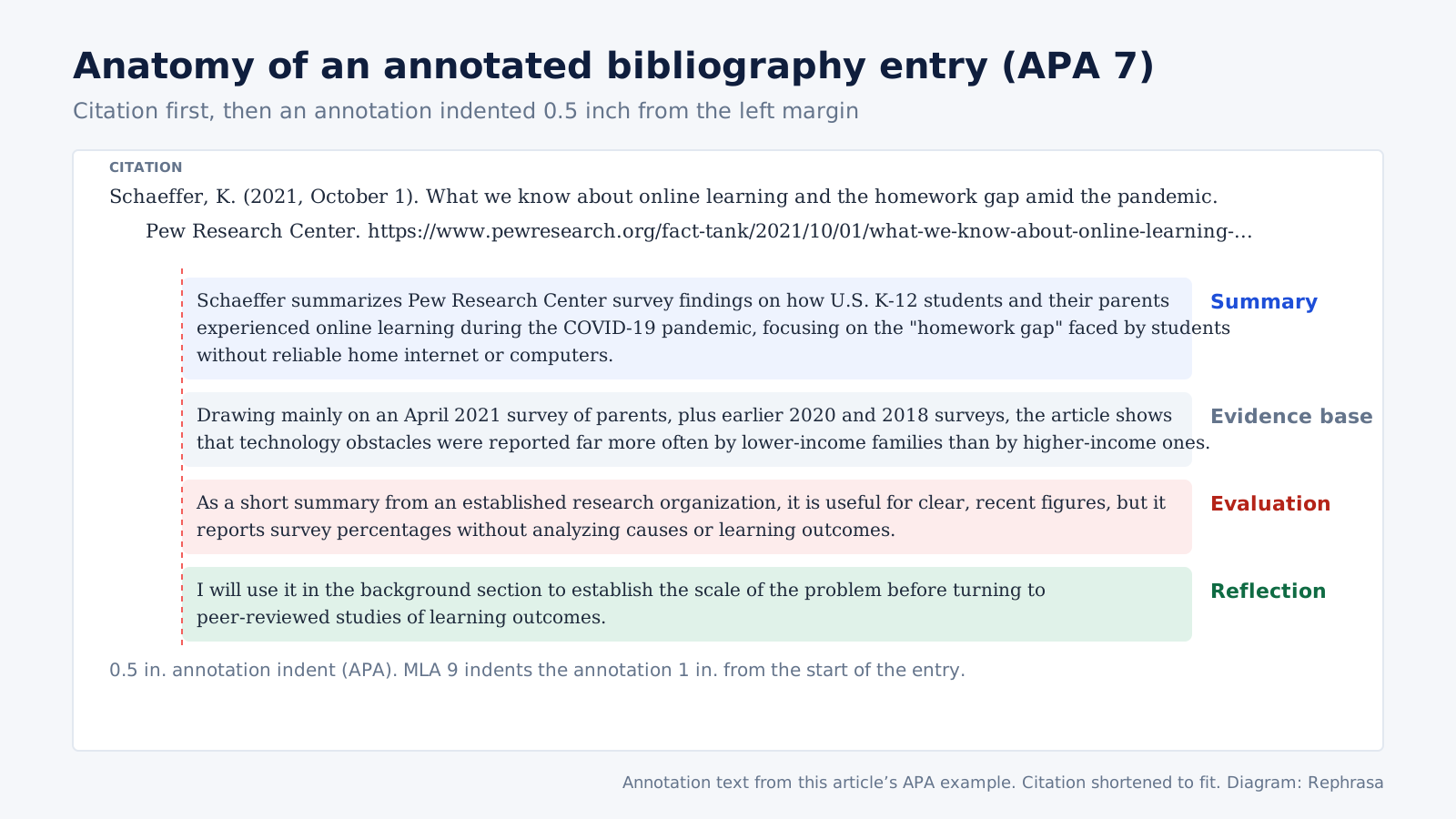
Schaeffer, K. (2021, October 1). What we know about online learning and the homework gap amid the pandemic. Pew Research Center. https://www.pewresearch.org/fact-tank/2021/10/01/what-we-know-about-online-learning-and-the-homework-gap-amid-the-pandemic/
Schaeffer summarizes Pew Research Center survey findings on how U.S. K-12 students and their parents experienced online learning during the COVID-19 pandemic, focusing on the "homework gap" faced by students without reliable home internet or computers. Drawing mainly on an April 2021 survey of parents, plus earlier 2020 and 2018 surveys, the article shows that technology obstacles were reported far more often by lower-income families than by higher-income ones. As a short summary from an established research organization, it is useful for clear, recent figures, but it reports survey percentages without analyzing causes or learning outcomes. I will use it in the background section to establish the scale of the problem before turning to peer-reviewed studies of learning outcomes.
Look at how the four sentences divide the work. Sentence one is the summary. Sentence two names the evidence base without listing every statistic. Sentence three evaluates the source, including its limits. Sentence four is the reflection. That is about 110 words.
One detail is worth copying from this exercise. When we opened the link, Pew had moved the article to a new "short-reads" address and the old URL now redirects. A reader needs a working link, so in your own list you would use the current address: the article on the Pew Research Center site.
The APA rules for in-text citations still apply inside an annotation if you mention other works. The Felician guide notes that you usually do not need to cite the work being annotated, because the entry above makes the source clear, but you should add in-text citations when an annotation refers to several works. Our guide to APA in-text citation rules covers that format, and the APA title page guide shows how to set up the cover page if your assignment needs one.
MLA annotated bibliography example (9th edition)
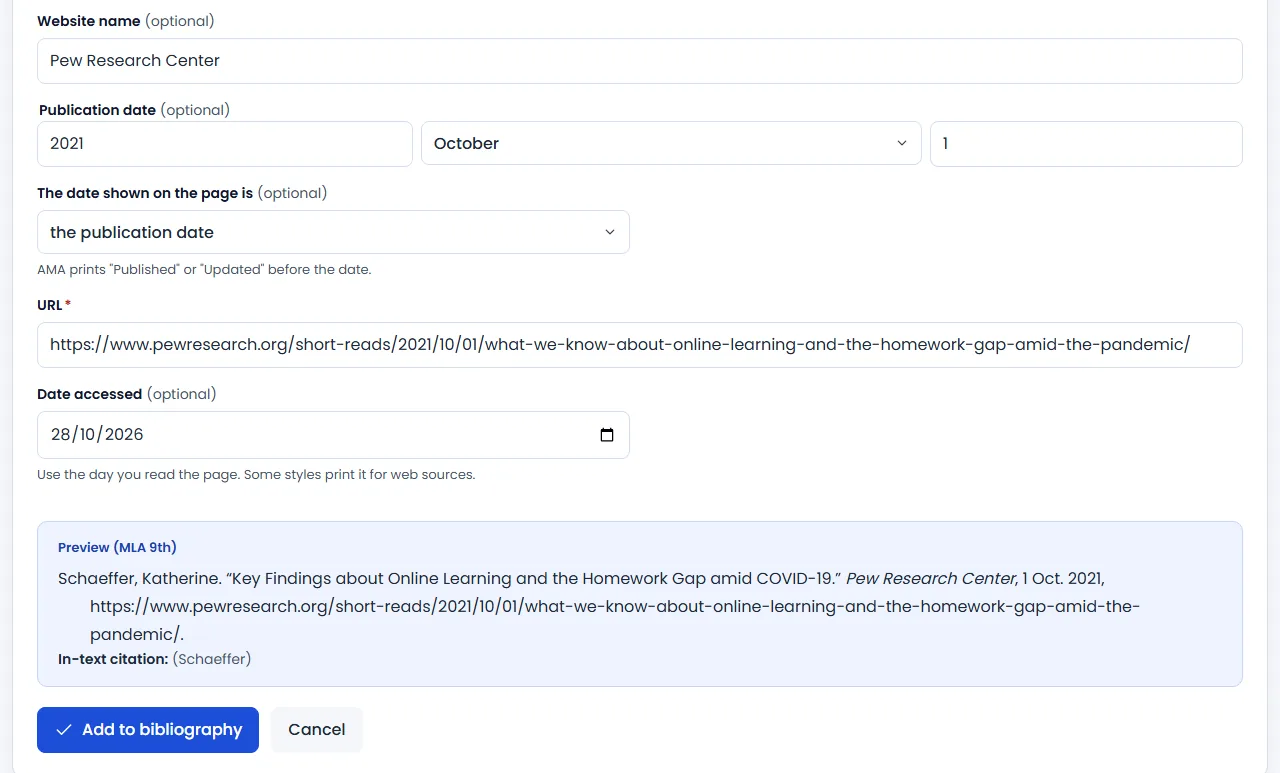
Here is the same source as an MLA works cited entry, followed by an annotation. MLA 9 lowercases prepositions such as "about" and "amid" in titles, puts the article title in quotation marks, italicizes the website name, and uses the day-month-year date format.
Schaeffer, Katherine. "What We Know about Online Learning and the Homework Gap amid the Pandemic." Pew Research Center, 1 Oct. 2021, www.pewresearch.org/short-reads/2021/10/01/what-we-know-about-online-learning-and-the-homework-gap-amid-the-pandemic/.
This short report summarizes Pew Research Center surveys on the "homework gap" in the United States during the COVID-19 pandemic. It shows that lower-income parents were much more likely than higher-income parents to say their children faced technology obstacles, such as doing schoolwork on a cellphone. The figures are recent and clearly sourced, but the piece describes patterns rather than explaining their causes. It gives my essay a reliable starting point for the scale of the problem.
MLA also accepts a shorter style. The MLA Style Center says annotations "are generally written as succinct phrases" and gives this example, where the phrase follows the entry directly:
Harbord, Janet. The Evolution of Film: Rethinking Film Studies. Polity, 2007. A synthesis of classic film theory and an examination of the state of film studies as of 2007 that draws on contemporary scholarship in philosophy, anthropology, and media studies.
If you write full sentences, as in our Pew example, the annotation starts on a new line below the entry. The same MLA page also lists what an annotation should leave out: it "should not rehash minor details, cite evidence, quote the author, or recount steps in an argument." That is why the MLA example above mentions one telling pattern instead of the dozen percentages in the report. For the citations you place in your essay itself, see our guide to MLA in-text citations.
How to write an annotated bibliography, from search to final list
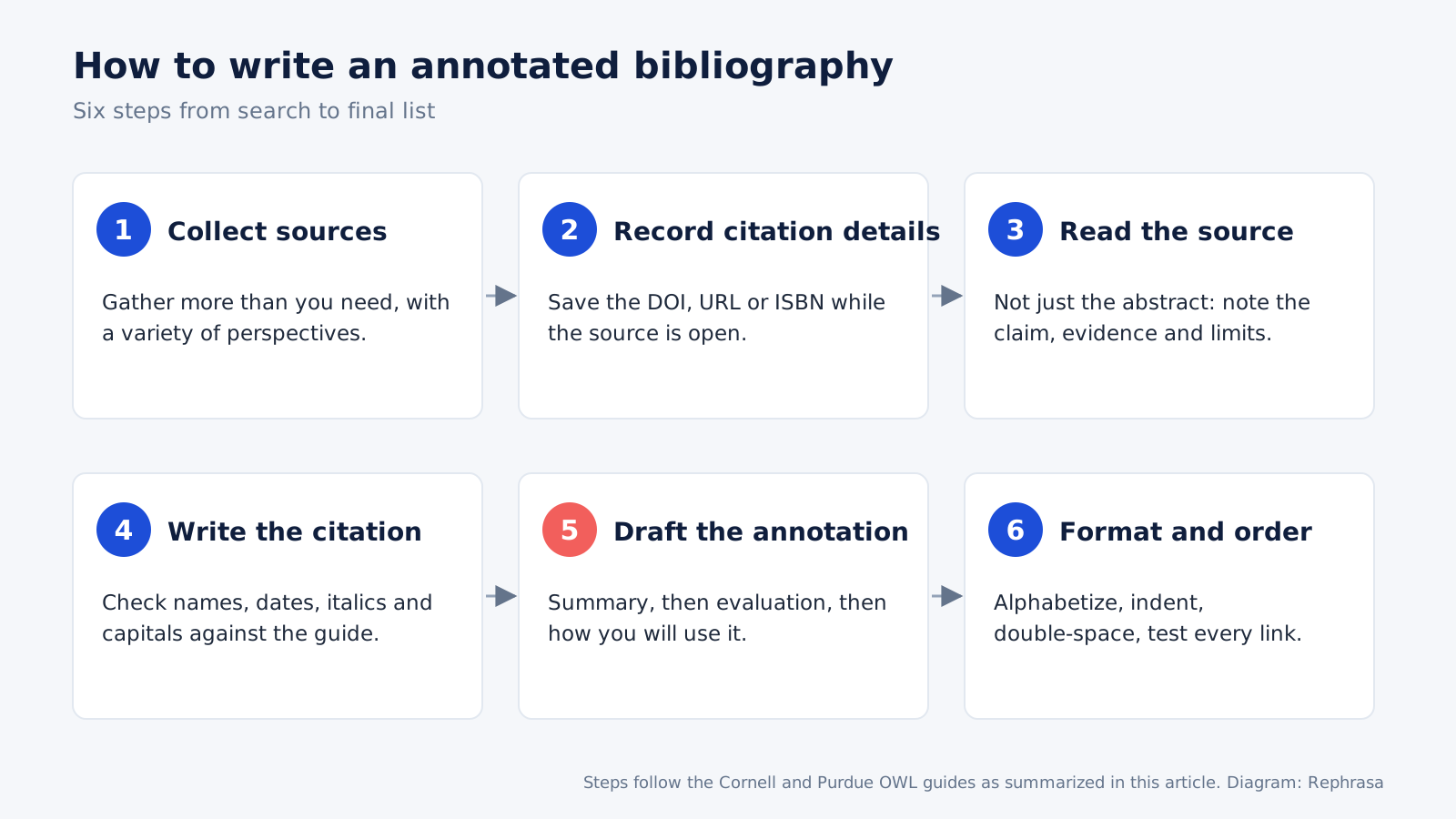
This is the process we recommend. It follows the order in the Cornell and Purdue guides, with a few checks added at the points where drafts usually go wrong.
- Collect more sources than you need. Cornell suggests choosing works that give "a variety of perspectives on your topic."
- Record the citation details as you go. Save the DOI, URL, or ISBN for every source while it is open in front of you.
- Read the source, not just the abstract. Skim the method and conclusion at minimum. Note the main claim, the evidence type, and anything that limits the findings.
- Write the citation in your required style. Check author names, dates, italics, and capitalization against the style guide or a checked generator result.
- Draft the annotation in your own words. Summary first, then evaluation, then one sentence on how you will use it. Close the source while you write, so you are not tempted to borrow its phrasing.
- Format and order the list. Alphabetize, apply the hanging indent and the annotation indent for your style, double-space, and click every link once more.
A practical tip: write each annotation within a day of reading the source. Annotations written in one rushed sitting tend to sound identical, and the evaluation sentence is the first thing to disappear.
Let a generator build the citation, then write the annotation yourself
The citation is the mechanical half of an annotated bibliography, and it is the half a tool can do well. Our free citation generator looks up the details from a DOI, a URL, or an ISBN, lets you correct the fields, and formats the entry in APA 7, MLA 9, Chicago, Harvard, IEEE, or AMA. If you only need one style, start from the APA citation generator or the MLA citation generator, or paste an identifier straight into DOI to citation or the ISBN citation generator. Check the result against the style guide, because publisher metadata is sometimes incomplete.
The annotation is different. It records your judgment of a source you have read, so it has to come from you. We would not hand that part to a tool: it cannot know why the source matters for your project, and a summary that only rewords someone else's text is still their content.
The same holds for paraphrasing in general. If you use an academic paraphrasing tool to smooth a draft you wrote yourself, the ideas still belong to the source, so the citation stays.
Common annotated bibliography mistakes
These problems cost the most marks, and all are quick to fix:
- Pasting the abstract. It is descriptive only and it is not your writing. Cornell's guide is explicit that annotations go beyond abstracts.
- Summary with no evaluation. Unless your brief asks for descriptive annotations, add at least one sentence on reliability, limits, or audience.
- Listing statistics. MLA advises against citing evidence in an annotation. Name the pattern, not every number.
- Wrong indent for the style. APA indents the whole annotation 0.5 in.; MLA 9 indents it 1 in. from the start of the entry.
- Dead links. As the Pew example showed, URLs move. Click every DOI and URL before you submit.
- Ignoring the brief. Number of sources, word count, and annotation type are set by your instructor, and the Felician guide notes that these requirements come from the instructor rather than the manual.
Get those right and an annotated bibliography stops being busywork: the summaries feed your literature review, and the citations drop straight into your final reference list.
Frequently asked questions
What is an annotated bibliography?
It is a list of sources in which each citation is followed by a short paragraph, the annotation, that summarizes the source and usually evaluates it and explains how it fits your research. The citations follow a style such as APA or MLA.
How long should an annotation be?
Follow your instructor first. Without other guidance, about 150 words is common: the Cornell University Library guide describes annotations as usually about 150 words, and the MLA Style Center says they should generally be no more than one paragraph.
How do you format an APA annotated bibliography?
Format each entry like an APA reference list entry with a 0.5-inch hanging indent, in alphabetical order and double-spaced. Start the annotation on a new line and indent the whole annotation 0.5 inches from the left margin.
How is an MLA annotated bibliography different from APA?
In MLA 9 the list is titled Annotated Bibliography or Annotated List of Works Cited, each entry is formatted as a works cited entry, and the annotation is indented one inch from the start of the entry. MLA also allows short phrase annotations right after the entry.
Can a citation generator write my annotated bibliography?
A citation generator can build and format the citations from a DOI, URL, or ISBN. The annotation has to be your own summary and judgment of a source you have read, so write that part yourself.
Do I need to cite the source inside its own annotation?
Usually not, because the entry above the annotation already identifies it. If the annotation mentions other works, add in-text citations for them.
What are the types of annotations?
There are three common types. A descriptive (informative) annotation summarizes the topic, scope and main findings. An evaluative (critical) annotation summarizes and then judges strengths, limits, bias and authority. A reflective annotation adds how the source shapes your own argument or research question. If the brief names no type, an evaluative annotation with one reflective sentence at the end is a safe choice.
Sources
- APA Style: Reference lists versus bibliographies
- APA Style: Reference list setup
- APA Style: Sample papers (annotated bibliography student paper template)
- APA Style: Webpage on a website references
- MLA Style Center: What guidance should I give my students for preparing an annotated bibliography?
- MLA Style Center: Should I double-space between paragraphs in my annotated bibliography?
- Middlebury College Library: Annotated Bibliography (MLA Handbook 9th ed., 5.132)
- Purdue OWL: Annotated Bibliographies
- Purdue OWL: Annotated Bibliography Samples
- Cornell University Library: How to Prepare an Annotated Bibliography
- Felician University Library: Annotated Bibliographies (APA 7th edition)
- Pew Research Center: What we know about online learning and the homework gap amid the pandemic